
By Hadi Kahalzadeh
Two weeks ago, amid fragile negotiations with the U.S. and mounting domestic tensions, Iran’s Supreme National Security Council set a nationwide 25% ceiling on rent increases. More than a housing measure, it was a dramatic signal that the cost-of-living crisis had crossed into the realm of national security.
The crisis is also visible at the kitchen table. Scenes now unfolding across the country echo the darkest days of the 1980-1988 war with Iraq: food bought in installments, groceries sold on credit, meals stretched by removing meat, counting eggs, and buying only what can be afforded day by day. These are not ordinary signs of inflation. They are the social markers of a country crossing from a cost-of-living crisis into a poverty crisis.
The 2026 war did not create Iran’s poverty problem. Years of sanctions, inflation, weak growth, and a shrinking middle class had already pushed millions of households close to the edge. But war has changed the nature of the crisis. It has turned economic pressure into social rupture, making poverty deeper and more visible in the basic domains of daily life: rent, food, work, and survival.
But how much of this deterioration can be attributed to the war itself? A precise answer will not be possible until Iran’s Household Expenditure and Income Survey (HEIS) for the Iranian calendar year 1405 (21 March 2025 to 20 March 2026) is released, likely in autumn 2027. However, indicators on industrial output, inflation, the labor market, payment networks, and food consumption, all point in the same direction: poverty is rising, vulnerability is spreading, and the middle class is shrinking further.
Iran did not enter this war with a healthy economy or a resilient middle class. It entered after a lost decade. My estimates from Iran’s HEIS indicate that average living standards in Iran remain 17% below levels in 2010-2009. In 2011, 64% of Iranians were either middle class or upper middle class, while 36% were poor or at risk of poverty. By 2024, the latest available HEIS, only 40% were lower- or upper-middle class, while 60% were poor or vulnerable. In other words, before the 12-Day War and Israeli attack in June 2025, a decade of sanctions, inflation, weak growth, and economic pressure doubled Iran’s poor and vulnerable population from 27 million in 2011 to 52.5 million in 2024.
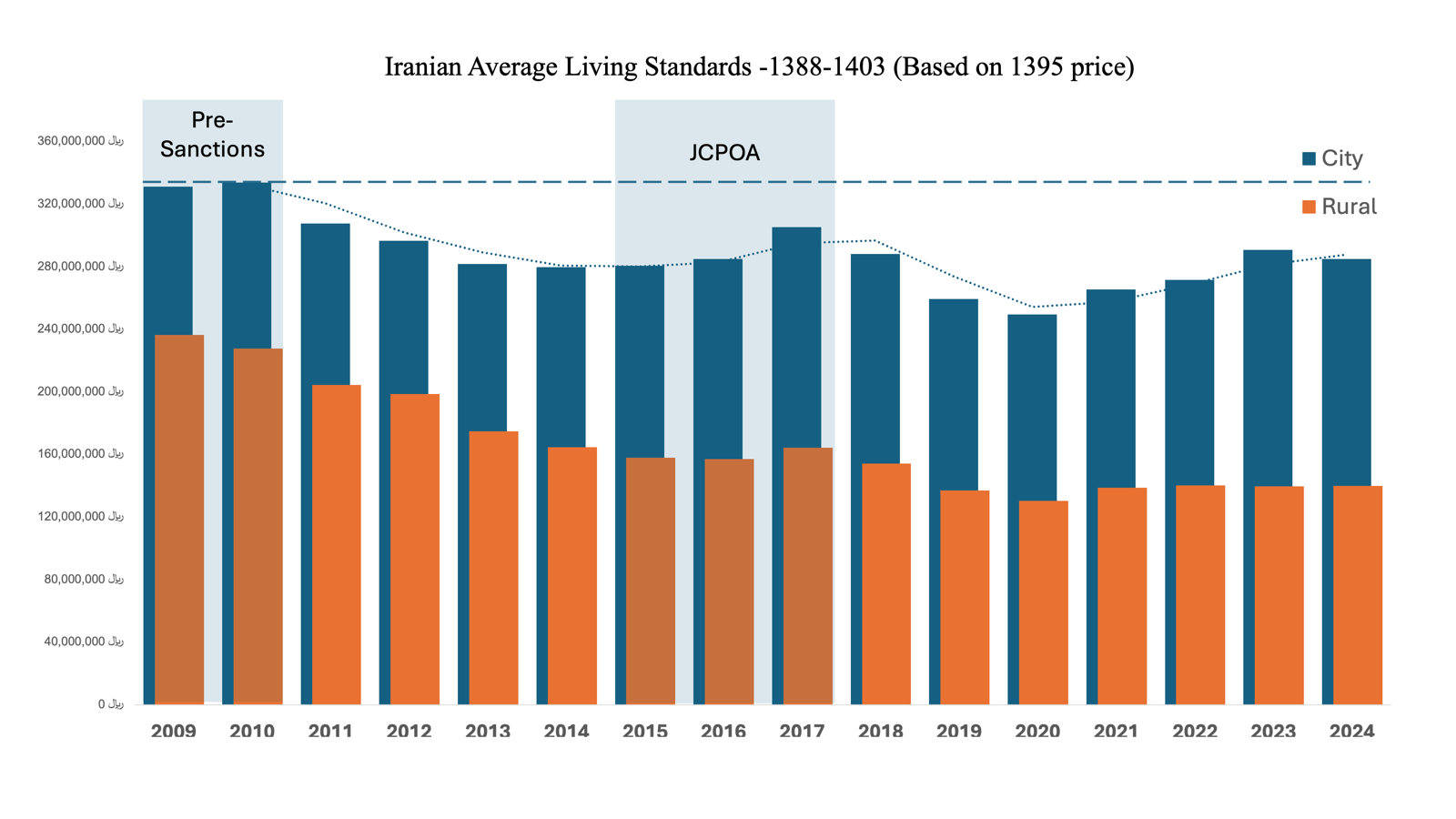
Source: Author’s calculations based on Iran’s HEIS data, adjusted for the 1395 (2016) price.
A combination of macroeconomic shocks including sanctions and the pandemic had significantly affected households’ income and expenditure balances through mechanisms including inflation, loss of income sources, unemployment, or catastrophic expenses. Typically, households respond to these shocks by adjusting their consumption patterns, utilizing savings, borrowing, and public social protection support.
The recent war added further pressure, accelerating poverty through several overlapping channels: destruction of production and jobs; inflation driven by supply disruptions; currency depreciation; a growing public deficit; erosion of household purchasing power and food security; and pressure on the state’s ability to compensate households.
In my earlier estimate for Bourse & Bazaar, I focused on the most affected part of Iran’s labor market and estimated that the war put 50% of jobs (10 to 12 million) at risk. Perhaps a more precise formulation is that, if we exclude 15 to 20% of the labor force, those who work as public employees or in the semi-private sector affiliated with the government, as the most protected part of the labor force, 30% modestly impacted, and 50% were significantly impacted.
The war damage to the labor market is not transient. The war knocked out 25% of Iran’s steel production capacity, 20% of its natural gas production, and 30% of its gas condensate output, disrupting the supply of inputs to petrochemical facilities, refineries, and power plants. Shortages of gasoline, fuel, petrochemical inputs, and steel can force other sectors to reduce production. Winter shortages of gas and electricity may generate a second wave of shutdowns, especially in energy-intensive industries. When steel, gas, petrochemicals, transport, and trade are all impaired at once, the damage spreads well beyond the initial targets. The result is not simply higher prices. It is the possibility of repeated employment shocks over the coming year.
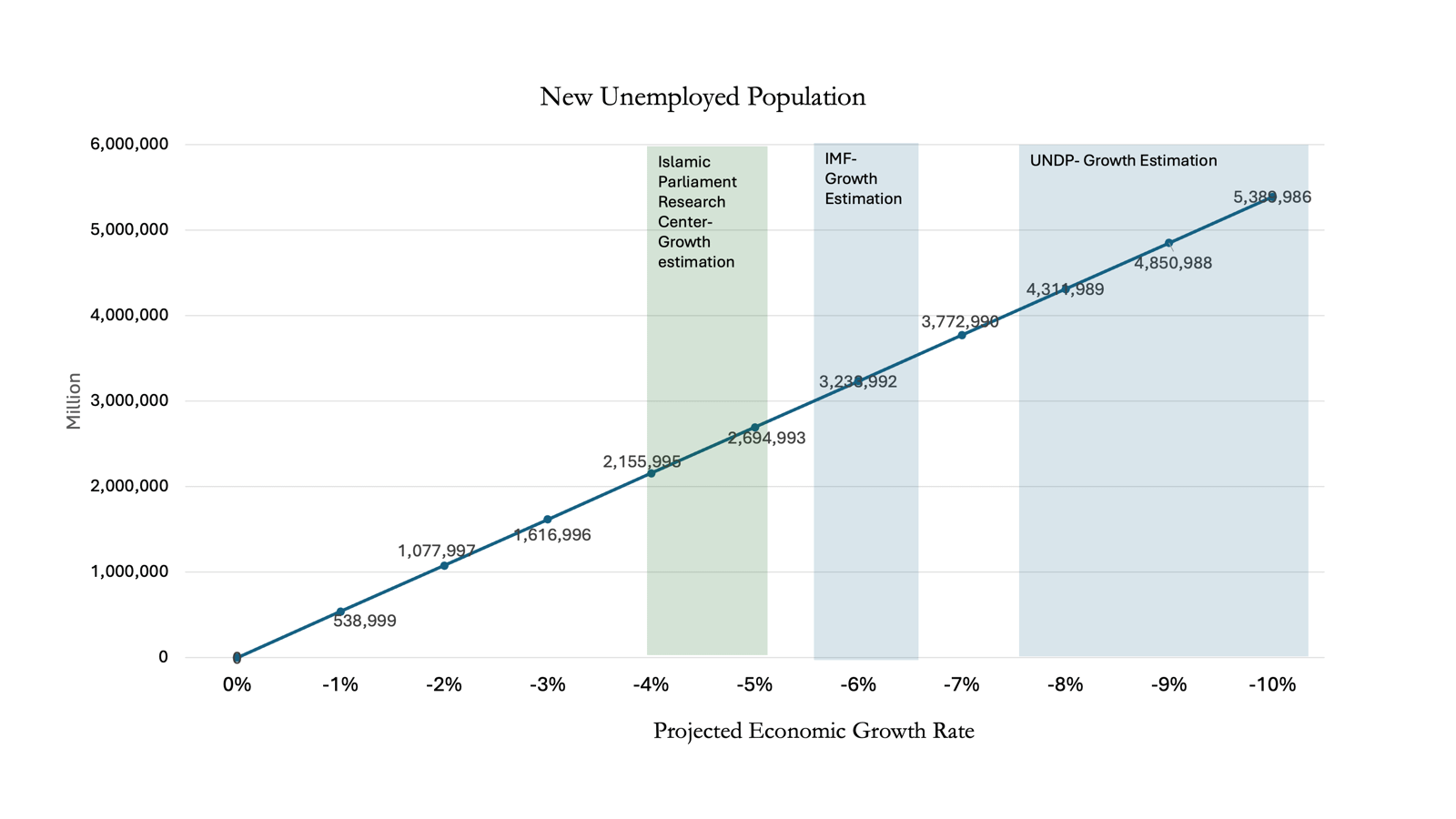
Source: Author’s calculations based on projected GDP contraction scenarios and Iran’s labor force data.
To examine the possible impact, I applied Okun’s Law, which relates unemployment rate to growth, with a plausible growth scenario in which GDP contracts approximately 4% to 8% in 2026. Under such conditions, the war could result in the loss of between 2 and 4 million jobs. In this sense, around 80% of the labor market was adversely affected by the war in some form, with 10 to 20% of workers expected to lose their jobs due to destruction, shutdowns, supply chain disruptions, falling demand, transport problems, internet shutdowns, wartime closures, and inflationary pressures. Iran’s social security data show that 440,000 jobs were lost by February 2025, owing to the 12-Day War, sanctions, the explosion at Rajaee Port, and weak investment. When we include these numbers, we can expect total employment to fall to as low as 22 million workers next year. A shock of that order would amount to one of the largest labor market contractions in the country’s modern history.
Iran entered the 2026 war already weakened, not only by unemployment but also by severe price instability. By February 2026, food prices were nearly 7.3 times higher than four years earlier. Some essentials rose even more dramatically: red meat was 9 times more expensive, oils 13.5 times, bread 7 times, and fruit 6.7 times. Meanwhile, monthly inflation in the Iranian calendar year ending March 2026 had averaged around 3.5%. However, the Iranian government’s decision to cut the subsidized hard currency allocated to essential food and medicine pushed monthly inflation to 9.5% in February. For poorer households, the effective inflation rate was even higher because food and basic goods make up a larger share of their spending. Inflation for lower-income groups had risen fourfold to roughly around 16% per month in February. For higher-income groups, inflation increased threefold.
War added new inflationary pressures: destroyed production, disrupted exchange, higher risk premiums, displacement, internet shutdowns, reduced trade, and a weaker currency. The dollar’s rise from 160,000 tomans to 190,000 tomans intensified expectations of further inflation. Monthly inflation in May 2026 reached to 8.8%. If such a trend continues, annual inflation above 100% is a plausible outcome, not an extreme scenario.
The cost of the 2,100-kilocalorie food basket rose by only 25% in the year before the war, measured in December 2025. The government’s new food assistance program covered almost 35% of the basket for nearly all Iranians following December. After the war, from February to May, the impact of the food subsidy assistance diminished as the basket’s cost rose to 6.8 million toman in May 2026, a 140% increase.
For households living on fixed wages, pensions, or unstable daily incomes, this pace of inflation is catastrophic. Even with increases in wages, food assistance, and the universal cash program, together totaling as much as 60%, inflation exceeding 60% still means purchasing power has fallen sharply, even for employed workers. It forces the same adjustment over and over: less meat, less dairy, lower quality staples, postponed medicine, postponed rent, and smaller purchases made more often because tomorrow’s prices may be worse.
Data from Iran’s Shaparak, an electronic card payment network, show that during the winter and wartime period, transaction volumes declined by 18% compared with the same period in the previous year, indicating shrinking household demand and collapsing incomes. Food spending remained more stable, but spending on culture, education, travel, and other discretionary items declined sharply. Around 65% of Shaparak’s purchases are made by the three upper deciles, suggesting that economic pressure has extended even into upper-income groups. Even better-off households appear to be cutting back and changing the composition of their spending, protecting food consumption while reducing discretionary purchases.
I applied a historical inflation-poverty correlation to estimate potential poverty in 2025 and 2026. I used data on poverty and inflation in both urban and rural areas at the province level between 2009 and 2024 and applied panel regressions. If the inflation rate exceeds 80% in 2026, we can expect the national poverty rate to increase to 40%. Poverty in rural areas could reach 50%. Of course, this is a projection, not a final poverty estimate.
My findings also aligned with a recent scenario estimate by the United Nations Development Program, which used economic contraction and suggested that a 2026 war could increase the number of people living below the $8.30-per-day international poverty line (2021 PPP) to 41% in 2026, depending on the war’s magnitude.
My findings also indicate that the middle class may shrink by 4-6% during periods of 80-100% inflation. If this is the case, we can expect that the lower and upper middle classes will account for 30% and 70% of Iranians, including 40% of the poor and 30% vulnerable and at risk of poverty.
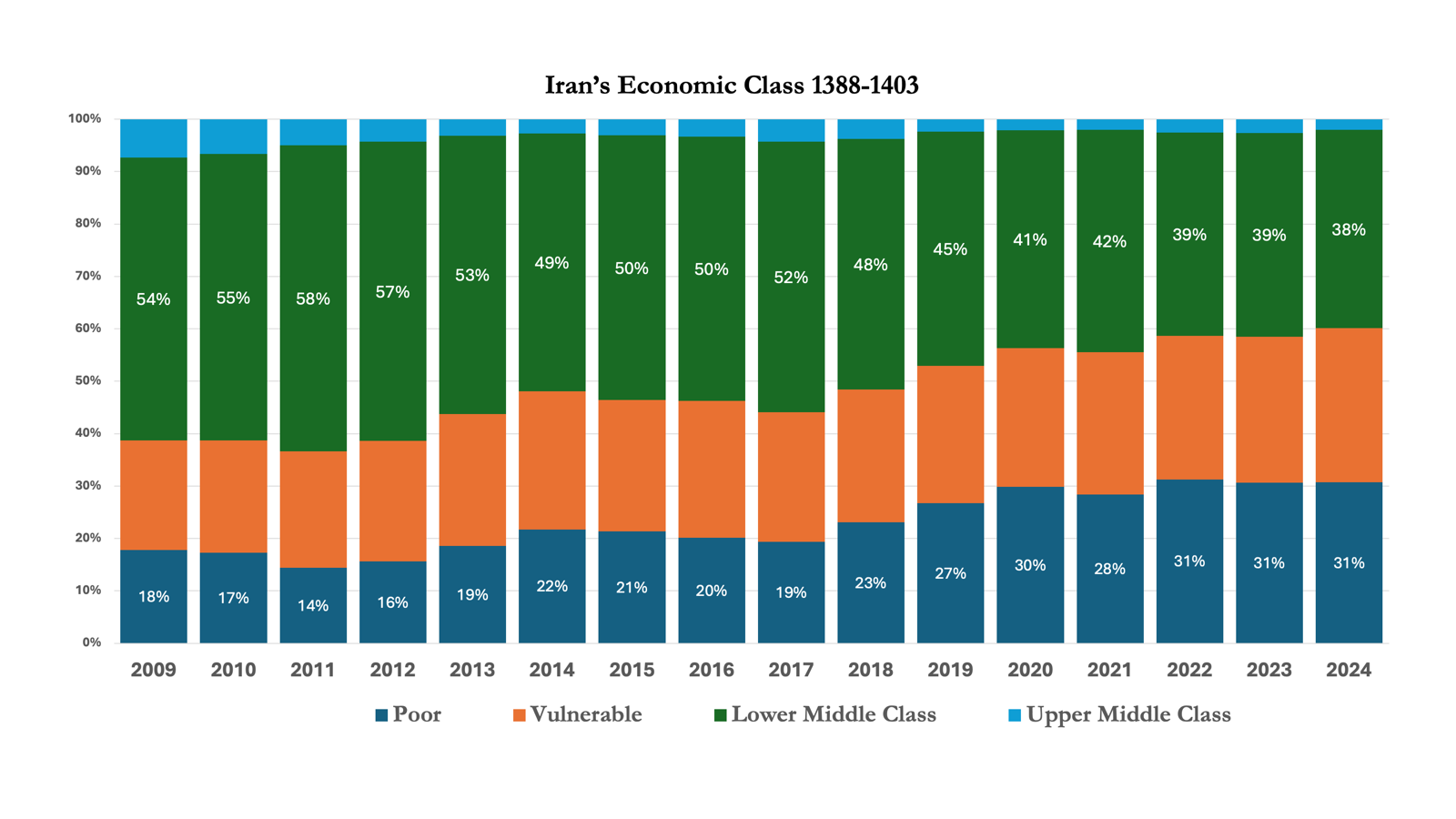
Source: The author estimates poverty in Iran using the Cost of Basic Needs (CBN) method.
In barely over a decade, Iran’s social pyramid did not just flip; it collapsed. The combination of sanctions, blackouts, corruption, mismanagement, and war halved Iran’s middle class, from 65% in 2011 to 35% in 2026. The middle-class majority became a minority, and poverty and vulnerability became the majority of the population, while poverty itself deepened. In 2011, before the intensification of U.S. sanctions in 2012, about 10% of the poor population lived in extreme poverty, unable to meet even basic food needs. By 2024, extreme poverty had doubled to around 20% of the poor, indicating that more impoverished households had fallen below the subsistence level. In 2026, it is expected that more than 25% of the poor population, around 10 million Iranians, will be unable to meet even their basic needs, placing them in the extremely poor category. This means that while Iran’s poor population roughly tripled after 2011, the number of Iranians living in extreme poverty increased by roughly fivefold.
My estimate, drawn from HEIS data, indicates that while 40% of Iranian households were unable to afford the full food basket recommended by the Ministry of Health in 2016, that share doubled in 2024. Moreover, in that year, only the top 10% of the income distribution was able to readily afford the required intake of red meat and dairy. Given the sharp rise in food prices so far this year, only households earning more than 110 million tomans per month—roughly the top 3% of Iranian households—will be able to afford the full food basket recommended by health officials.
Government assistance is important for compensating for the adverse impact of the war on households. The Pezeshkian administration faces pressure to cut food assistance for the top three deciles and has already doubled the price of bread, the main source of calories for the bottom eight deciles. Even if the government wants to keep inflation in check, double food assistance, and cover only 2 million people with unemployment benefits and part of the lost pension funds, it would need an IRR 1.85 quadrillion or 31% of its budget. Even with such an allocation, it would only change the composition of poor and vulnerable households, not that of lower- to upper-middle-class families.
This is where the poverty crisis becomes a state-capacity crisis. War raises military and reconstruction costs while reducing fiscal space, disrupting production, weakening tax and social-insurance revenues, and increasing demand for subsidies and unemployment support. The state is therefore asked to protect more people with fewer resources. Even generous assistance may prevent some households from falling into extreme poverty, but it cannot easily rebuild the middle-class security that has been lost over the past decade.
The danger, then, is not only that more Iranians will fall below the poverty line. It is that war is turning poverty from a measurable economic condition into the organizing reality of everyday life. Iran’s next household survey will eventually count the poor. But the war is already producing something harder to reverse: a society in which insecurity has become the norm.
As housing costs become a national security concern, so too must bread, medicine, wages, and food security. For millions of Iranians, 3,500 sanctions designations and 40,000 U.S. and Israeli missiles have principally targeted household welfare, not military bases or government departments. The effects of economic pressure are made manifest in smaller portions of food, unfilled prescriptions, unpaid rent, and jobs that no longer pay enough to survive. The question now is whether the Islamic Republic understands that it cannot defend the nation in war while leaving households defenseless against poverty.
Hadi Kahalzadeh is a welfare economist. He is a non-resident fellow at the Quincy Institute and a research fellow at the Center for Global Development and Sustainability at Brandeis University. Before his academic career, he spent eight years as an economist at Iran’s Social Security Organization, analyzing the impacts of Iran’s economic and social policies.