
By Hadi Kahalzadeh
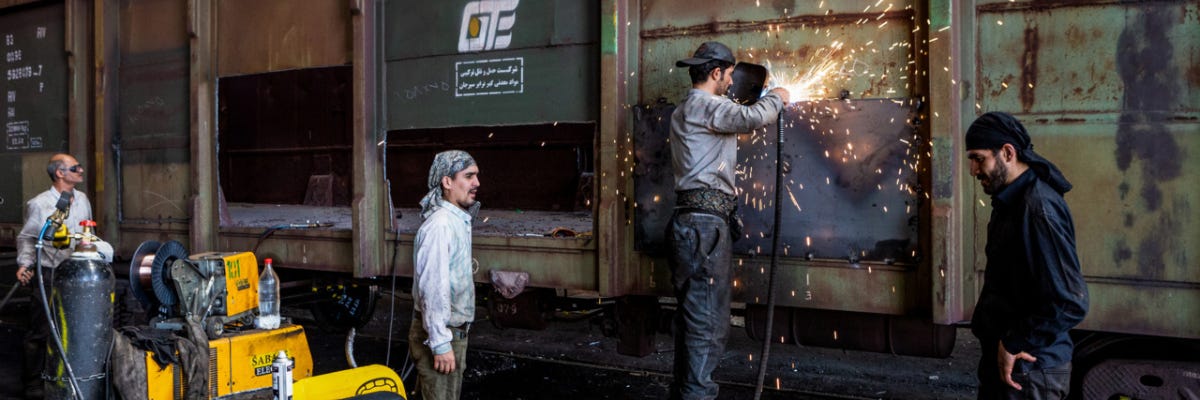
After forty days of war, Iran’s families are returning home under a fragile ceasefire. But the pause in the conflict may not prevent the coming shock to Iran’s economy. As ordinary Iranians confront the destruction of roads, ports, and industrial infrastructure, they are discovering that the war has taken away their jobs, their wages, and, for many, their only means of survival. If this war had a hidden target, it was not Iran’s military power projection; it was the labor market that sustains the livelihoods of ordinary citizens.
War has damaged more than 125,000 residential and civil buildings, including 339 health facilities, 32 universities, and 857 schools, and has directly destroyed over 20,000 industrial units, forcing many related businesses to shut down. In other words, around 20 percent of the country’s production units have been directly damaged. Iran’s ports and transportation systems, which move essential goods and raw materials across the country, have also been heavily damaged. According to some estimates, the war has already cause more than $300 billion worth of damage to civilian infrastructure alone, excluding military facilities. This staggering figure captures only the reconstruction cost, not the wider economic toll.
But war does not just destroy buildings. It breaks economic systems. Supply chains, transport networks, and commercial services have been disrupted, and many firms have suspended operations under the combined pressure of war, inflation, recession, and collapsing demand. What makes this especially striking is the pattern of the damage. The sectors hit hardest by U.S. and Israeli airstrikes represent the core pillars of employment and production: steel, construction, petrochemicals, pharmaceuticals, and retail.
Job Uncertainty
The pattern of attacks on infrastructure suggests that Israel and the United States mapped Iran’s labor market and struck at its core pillars. Among the thousands of destroyed production units, the damage to Iran’s steel sector is especially consequential. A review of Iran’s Labour Force Survey and Manufacturing Industries Survey suggests that steel is a critical input for 42 percent of Iran’s industrial supply chain and underpins activity across manufaturing, including automotive production, and construction. When steel supplies are interrupted, the consequences spread far beyond the plants themselves, rippling through manufacturing, transport, building activity, and the many jobs connected to them.
By my estimate, disruption to steel production and distribution threatens 1.8 million jobs across industrial sectors and 3.8 million jobs tied to construction. The petrochemical and pharmaceutical units, which were also damaged in the war and together account for around 30 percent of Iran’s industrial output, represent another major source of labor-market exposure. Because these sectors supply critical industrial inputs and essential goods, their disruption puts another 1.2 million jobs at risk.
About 10 to 12 million jobs, roughly 50 percent of Iran’s workforce, are now at risk. That does not mean all of those jobs have already disappeared. It means that a very large share of Iranian workers, mostly in the informal sector, now live under the shadow of furloughs or layoffs.
Even firms and sectors that have not been bombed are scaling back amid broader pressure from the war. Faced with recession, liquidity constraints, weak demand, and deep uncertainty about what comes next, many are suspending production, postponing investment, and halting expansion. Inflation has made that shock even harsher. In March, point-to-point inflation reached 72 percent, one of the highest rates since the revolution. The long shutdown caused by the war, combined with falling family incomes and fears of further escalation, has reduced private consumption and depressed demand nationwide. Many small firms had hoped that the end-of-year season and the period around Nowruz would offer a chance to recover income through sales and service activity after earlier closures and lost sales. Instead, many now face insolvency and shutdown.
The effects are especially visible in wholesale and retail trade, which employs 17 percent of Iran’s labor force, or roughly 4.1 million jobs. Taken together, industrial production, construction, wholesale and retail trade account for more than half of total employment in Iran. This does not mean the agricultural sector or other parts of the service economy have been spared. But because internet shutdowns have sharply limited visibility into conditions across regions and occupations, the full extent of labor-market damage remains difficult to measure in real time.
Considering the pattern of attacks, about 10 to 12 million jobs, roughly 50 percent of Iran’s workforce, are now at risk. That does not mean all of those jobs have already disappeared. It means that a very large share of Iranian workers now live under the shadow of furloughs or layoffs.
Even before the 40-Day War, Iran’s labor market was already fragile. Prolonged sanctions, stagflation, and lingering pandemic effects had weakened the country’s capacity to absorb macroeconomic shocks. From March to September 2025, Iran’s economy contracted by 0.5 percent owing to the compounding effects of drought, the April explosion at Shahid Rajaee Port, and the 12-Day War last June, resulting in the loss of 750,000 jobs.
Given the economic situation after the 12-Day War, the labor market is likely to continue to contract. If no further losses occur beyond those recorded since last September, and if only 30 percent of the 10 to 12 million jobs now at risk are eventually lost, Iran could lose approximately 3 to 4 million jobs. This would represent about a 15 percent contraction of the labor market, marking the largest decline in Iran’s modern history.
Difficult Response
The Islamic Republic appears to have planned for a six-month war scenario, including military readiness, the supply of essential goods, and the provision of subsidized loans, tax incentives, and exemptions for damaged production units. The administration has also announced that those who lose their jobs may be eligible for unemployment benefits equal to 55 percent of their wages, or at least the minimum wage. But many employees in the informal sector may not be eligible for benefits, and the financial burden of these commitments appears to exceed Iran’s capacity to meet them.
Providing 3 to 4 million unemployment benefits for six months, for example, would require nearly IRR 5 quadrillion. A 15 percent contraction in the labor market would also mean a 25 to 30 percent drop in revenue for the Social Security Organization, Iran’s largest pension fund. Filling that financing gap would require another IRR of 5 to 6 quadrillion. Altogether, the financial burden of war-induced unemployment would consume at least 20 percent of Iran’s public budget, which is already running a large deficit.
Whether by design or by consequence, this war has struck at the foundations of how Iran’s most vulnerable citizens work, earn, and survive. An estimated 10 to 12 million jobs are now under threat, putting the main source of income for millions of households in both the formal and informal private sectors at risk. And these estimates do not even include the 22 percent of Iranian households that rely on public-sector wages. As so often in war, the highest costs are falling on those least protected by the state welfare benefits.
Even if the ceasefire holds, Iran’s most vulnerable people will suffer the long-term consequences of this 40-day conflict. The bitter irony of this war is that the very population President Trump claimed to support by this war is now bearing the brunt of the damage.
Hadi Kahalzadeh is a welfare economist. He is a non-resident fellow at the Quincy Institute and a research fellow at the Center for Global Development and Sustainability at Brandeis University. Before his academic career, he spent eight years as an economist at Iran’s Social Security Organization, analyzing the impacts of Iran’s economic and social policies.
Section: (vision-iran-initiative) Photo: Ali Hamed Haghdoust