By Esfandyar Batmanghelidj and Josefine Petrick
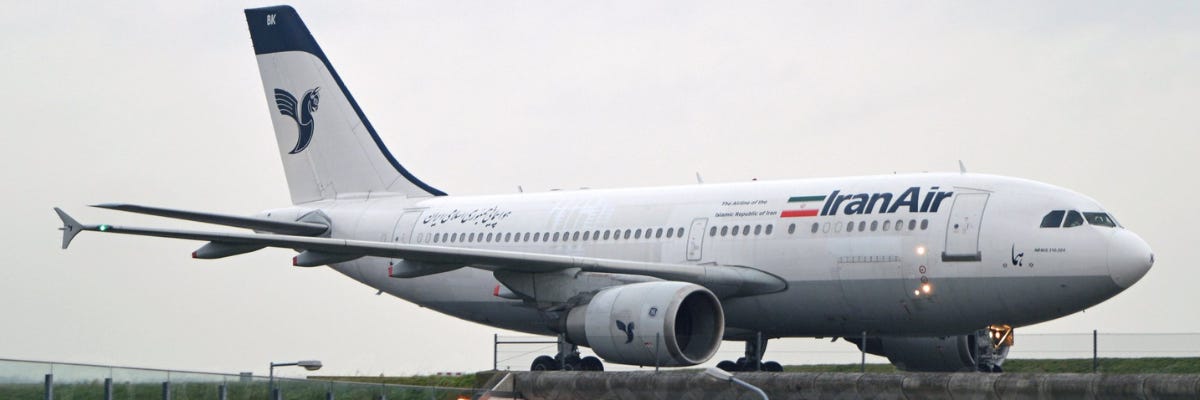
On September 8, 2026, the Trump administration issued new sanctions targeting Iran’s aviation industry. In its announcement of the new sanctions, the Treasury Department claimed the action would target Iran’s commercial airlines which have “long supported the Iranian regime’s destabilizing activities, with the IRGC using ostensibly private airlines… for the procurement and transport of weapons.”
But the measures will impact all Iranian passenger air travel, making it more difficult for Iranians around the world to remain connected. Perhaps more concerningly, any further reduction in civilian flights to Iran would impact certain forms of trade, including Iranian imports of pharmaceuticals and medical products. Just over 60% of Iran’s medical imports arrive in Iran via air, according to customs data. Notably, air freight accounts for 8.4% of all Iranian imports, meaning that medical goods are roughly seven times more dependent on aviation linkages than Iranian imports generally.
The new measures, therefore, represent the latest instance in which the tightening of sanctions risks significant harm for ordinary Iranians, in this case because of the impact on the availability and affordability of critically important medical goods.
The Treasury Department’s Office of Foreign Assets Control (OFAC) suspended General License J-1 that allowed foreign airlines to operate connections to Iran, even when their planes contained more than 10% U.S.-origin components. This move was coupled with the suspension of three regulatory provisions that authorized payments for overflights of Iranian airspace, bunkering and emergency repairs, and safety protocols. Although OFAC issued General License DD to allow for a 15-day transition period, these measures effectively bar non-U.S. airlines from operating connections to Iran. OFAC also sanctioned 27 Iranian airlines and eight third-country companies, aiming to force foreign airports and aviation services companies to cease serving Iranian carriers.
These actions have been taken as part of “Operation Economic Outcast.” On August 24, 2026, President Trump updated Executive Order 13902 to target five additional sectors, including aviation. OFAC justified the measures by pointing to Mahan Air, an airline it had previously linked to weapons of mass destruction proliferation, arguing that the newly sanctioned entities had continued to support its operations.
Long-Running Pressures
Iran meets most of its demand for pharmaceutical and medical products domestically. The country boasts world class, state and privately owned drug manufacturers that produce everything from ibuprofen to cancer medication to GLP-1 inhibitors. Some of these drug makers were directly targeted in the early stages of U.S. and Israeli airstrikes – incidents that may constitute war crimes. But no country can be self-sufficient, as even the domestic production of pharmaceutical and medical products requires Iran to import a wide range of production inputs and machinery.
While trade in these goods is technically exempt from sanctions, financial restrictions have negatively impacted Iran’s healthcare system. Iranian importers can struggle to source products from major pharmaceutical manufacturers. Even when there is a willing seller and the transaction is covered by a U.S. general license, international banks frequently refuse to receive payments from Iranian banks.
Likewise, Iranian importers face challenges in arranging transportation, often paying a premium for delivery of their cargoes. These frictions have pushed the prices of many imported medicines higher. Most drugs and medical products are still available in Iran, but affordability remains a concern for many health professionals and patients, especially as the country’s general economic situation worsens.
Advanced therapies are especially vulnerable to sanctions barriers. Produced by a few specialist manufacturers and used by small numbers of patients, advanced therapies rarely get prioritized, and access is quickly lost when individual suppliers change their policies. In 2019, families of children with a painful skin condition called EB, were left in a dire situation when Mölnlycke, a Swedish firm, ceased sales of the only viable treatment to Iran.
Supply Chain Fragility
Most Iranian pharmaceutical imports arrive in the country by air. Many pharmaceutical and medical products tend to be small and light, making transport by air freight commercially viable. In the last Iranian calendar year, total imports of pharmaceuticals, medical devices, and medical equipment were valued at just over $3 billion. The volume of these imports totaled around 30,000 tonnes.
Historically, the majority of such imports arrived via cargo flights, but over the last decade, as the world’s major air cargo companies withdrew from the Iranian market, an increasing proportion of the freight has been delivered in the holds of passenger flights operated by international and Iranian airlines.
Flights operated by Lufthansa and Emirates were particularly important given the significant volume of imports from Germany, France, Switzerland, and the UAE. But in the wake of sanctions and war, many international airlines suspended flights to Iran. Air France and British Airways suspended their direct connections to Tehran in September 2018. Lufthansa suspended Munich and Frankfurt routes to Tehran in June 2025. Emirates ceased flights to Iran in February 2026, shortly after the start of the U.S. and Israeli war.
The impact of the new aviation sanctions on Iran’s medical supply chains will likely be significant and ordinary Iranians will likely face unwarranted harm. A simple review of the composition of the airborne imports makes the stakes clear.
As international airlines withdrew from the market, Iranian carriers came to play a more important role in international trade, including imports of pharmaceutical products. But now, the Trump administration aims to decisively interrupt the operation of Iranian airlines through broader designations and an aggressive enforcement posture, isolating Iran to an unprecedented degree. Fewer flights will mean less overall air freight capacity, which will in turn increase freight rates, especially to source cargo from key jurisdictions, such as Europe.
Concerningly, imports of pharmaceutical products are declining more quickly than Iran’s overall imports. Since the start of Trump’s maximum pressure sanctions in the Spring 2018, total pharmaceutical imports have fallen around 35%. In the same period, overall imports actually grew around 15%. Given that medicines constitute essential goods where demand should be most robust, this is the opposite of the expected trend.
Some of the decline may reflect efforts by Iranian medical firms to boost domestic production of key products, thereby reducing import dependence. But more likely, the accelerating decline in medical goods imports reflects the cumulative impact of tightening sanctions on underlying supply chains. Since 2018, U.S. maximum pressure sanctions have become so stringent that even exempt humanitarian trade is being significantly disrupted.
Healthcare Impacts
The impact of the new aviation sanctions on Iran’s medical supply chains will likely be significant and ordinary Iranians will likely face unwarranted harm. A simple review of the composition of the airborne imports makes the stakes clear. Looking at the most recent customs data, which covers the 10 months until February 2026, over 30% of medical imports that pass through IKA are classified as “medicaments containing hormones,” a category which includes insulin for treatment of diabetes and certain cancer treatments. Just over 10% of the imports are vaccines, both for human and veterinarian use. Another 6% includes blood products used to treat infections or support clotting.
Given the importance of these medications for Iran’s health system, Iranian importers will seek to adapt to further disruptions in passenger flights. More trade could be routed through third countries which may not adhere to U.S. sanctions regulations as strictly. Importers may also shift to overland trade, taking advantage of the compactness and lightness of many of these imports to maintain imports. But these adaptations will introduce further costs and fragility into key supply chains. There are also some hard limits to consider. Certain medications and therapies are produced in just a few countries. Others need to be transported with strict temperature controls. In certain instances, when a supplier relationship is terminated, patients are left without any alternative treatments.
By creating more fragility in medical supply chains, the new sanctions will also leave Iran especially vulnerable during future public health emergencies or natural disasters, when the country’s healthcare system may need to rapidly increase imports of particular drugs, medical products, medical devices, or personal protective equipment. Sanctions inhibited Iran’s response to the COVID-19 pandemic, including by limiting Iran’s access to the global COVAX vaccine program. While the Biden administration issued additional guidance to reaffirm the exempt status of medical trade, Iran was left last in the line for critical supplies given the inherent financial and logistical difficulties.
Although the Trump administration claims that the new sanctions targeting Iran’s aviation sector are intended to “sever the economic lifelines that sustain the Iranian regime and the Islamic Revolutionary Guard Corps,” the effects will, once again, harm the most vulnerable people in Iran. More patients who need reliable and affordable access to pharmaceutical and medical products will see their health put at risk due to the sanctions. Some will face life-threatening consequences.
Esfandyar Batmanghelidj is Founder and CEO of the Bourse & Bazaar Foundation.
Josefine Petrick is a Policy Fellow at the Bourse & Bazaar Foundation, where she researches the intersection of sanctions policies and global public health.
Section: (integrated-futures-initiative) Photo: Nabil Molinari