
By Mehran Haghirian
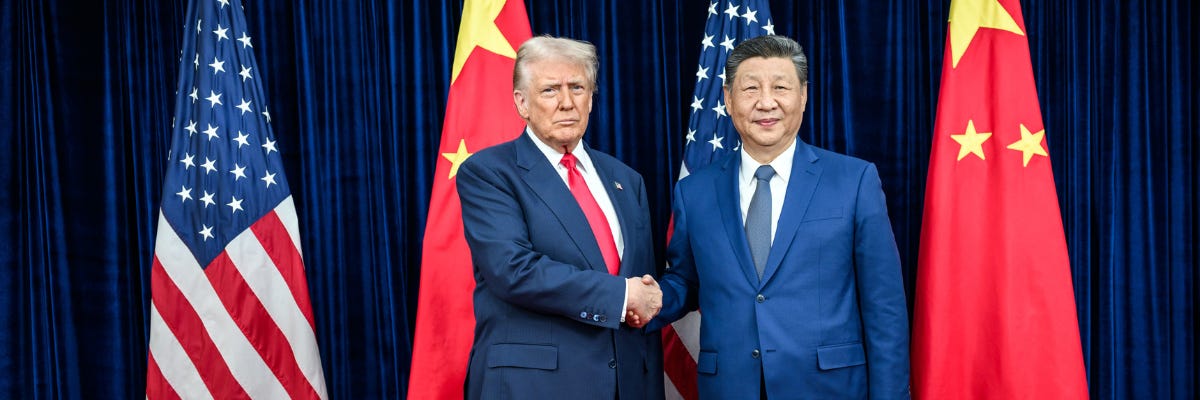
Donald Trump’s meeting with Xi Jinping in Beijing was not supposed to be about Iran. But the war in the Gulf looms large over the Beijing summit. While the conflict did not displace trade, technology, Taiwan, critical minerals, or the wider U.S.-China rivalry, Trump arrived in Beijing needing Xi’s help over the thorny issue of Iran.
China could use its influence to end the war on Iran and the instability in the Gulf. China’s role matters because of its interfaces with nearly every part of this crisis. It is the guarantor of the 2023 Iran-Saudi agreement signed in Beijing. It has been engaged with Pakistan and others in mediation efforts since the war began. It has used its position at the United Nations to shape the multilateral response to the crisis. It is the foremost customer of energy from the Gulf Cooperation Council states and from Iran. Its firms, trading networks, and nationals have been affected by U.S. sanctions, the risks around the Strait of Hormuz, and the disruption caused by the war. Chinese officials have also put forward a political approach through Xi Jinping’s four-point proposal on peace and stability in the Middle East.
China’s actions should be understood in continuity with its expanded role in Gulf diplomacy since 2023. As the guarantor of the Iran-Saudi détente, Beijing has played a role in reducing tensions between Tehran and Riyadh over the past three years. Much of that role has remained outside public view, just as it did when the agreement was signed. In March 2023, China’s role became fully visible only at the final moment, when reports emerged shortly before the announcement that Iranian and Saudi security officials were in Beijing to finalize the deal.
China has for years spoken of transforming the Gulf into an “oasis of security.” The phrase reflects Beijing’s view that the Gulf should move toward an inclusive regional security arrangement.
A similar dynamic may be at work today. Not every consequential part of this diplomacy is announced as it happens. China approach has often centered on quiet engagement, creating space for regional parties to negotiate. Chinese officials presented the 2023 agreement between Iran and Saudi Arabia as part of a broader, yearslong effort to move the Gulf toward dialogue and away from confrontation. That logic has become more important since the war began in February.
The war has also shown the limits of the Iran-Saudi détente, pointing to lessons for Chinese policymakers as consider their next steps. The bilateral deal did not prevent direct confrontation. Saudi Arabia, like the UAE, attacked Iran directly during the war. Riyadh’s position, however, has remained different from Abu Dhabi’s in one important respect. Saudi Arabia has remained diplomatically engaged with the Islamic Republic. It could be argued that Saudi offensive action, combined with possible Chinese involvement behind the scenes, helped prevent the tit-for-tat from escalating further. Riyadh showed that it could respond militarily while keeping a political channel open.
That point matters for China’s role. The 2023 agreement did not produce complete reconciliation between Iran and Saudi Arabia. It did not entirely eliminate mistrust. But it preserved a channel at a moment when the region could have moved toward a wider and less manageable war.
China has for years spoken of transforming the Gulf into an “oasis of security.” The phrase reflects Beijing’s view that the Gulf should move toward an inclusive regional security arrangement. Since the outbreak of the war, China has tried to turn that language into a diplomatic strategy.
On March 31, China and Pakistan issued a five-point initiative for restoring peace and stability in the Gulf and the wider Middle East. It called for a ceasefire, de-escalation, dialogue and negotiation, protection of civilians, and the safeguarding of shipping lanes and energy facilities. The initiative mattered because it showed that China was already working with Pakistan and other in the newly formed quadrilateral that also included Turkey, Egypt, and Saudi Arabia.
Beijing then moved further in April, when during Xi Jinping’s meeting with the UAE’s Sheikh Khaled bin Mohamed bin Zayed, China put forward four propositions on peace and stability in the Middle East. Xi encouraged peaceful coexistence, national sovereignty, international rule of law, and a balance between development and security. Chinese officials have also signaled that China wants to play a role in establishing a new post-war regional architecture. This moved Beijing beyond ceasefire diplomacy and indicates Beijing’s desire to shape the political framework that follows after the war ends.
Beijing’s approach is shaped by its own interest. It wants to preserve influence with Iran, but it also wants strong ties with Saudi Arabia, the UAE, Qatar, Kuwait, Oman, and Bahrain. It wants to push back against U.S. pressure, but it does not want a regional war to threaten Chinese energy flows, investments, ports, shipping routes, and supply chains across the Gulf and the wider Global South. China’s support for Iran exists within these limits.
China’s conduct at the United Nations has also been telling. An earlier Bahrain-backed resolution attracted 135 co-sponsors, with China abstaining. A later Bahrain-backed resolution on shipping protection in the Strait of Hormuz was vetoed by China and Russia. Another draft is now under discussion and is likely to face the same obstacle. Chinese actions at the UN showed that Beijing was prepared to block a line backed by the United States and others when it believed the text was too one-sided against Iran or risked worsening the crisis.
The UN track shows that China’s posture is not detached neutrality. By vetoing the resolution and rejecting approaches it views as imbalanced, Beijing has made clear that it has its own view of how pressure on Iran should be handled, how maritime security should be framed, and how the Gulf crisis should be internationalized. China wants to remain central to the diplomatic process without allowing the Security Council to become a platform for one-sided coercion. Its diplomacy is helping set the boundaries of the war’s diplomatic track, which matters even more considering the personal relationship between Trump and Xi.
The Strait of Hormuz is where China’s influence and limits are clearest. Iran has reportedly allowed the transit of Chinese vessels, with around 30 ships, mostly Chinese, passing through the strait as Trump was in Beijing. Tehran may see this move as proof that it can regulate access to the waterway while rewarding friendly states. But China is unlikely to treat such arrangements as anything more than wartime exceptions. Beijing may accept practical accommodations to keep ships moving during the conflict. It will not want Iran to institutionalize a system in which Tehran decides who can pass, under what conditions, and at what cost.
Senior U.S. and Chinese officials have agreed that no country should be allowed to exact shipping tolls in the Strait of Hormuz. This is one of the rare areas where Washington and Beijing have found common ground during the war. For the United States, it is about pressuring Iran to give up its hostile actions around the strait. For China, it is about making sure the Hormuz does not become a tool of permanent Iranian leverage over global shipping and energy flows. Beijing may oppose U.S. coercion against Iran, but it also opposes any Iranian effort to turn wartime control into a standing regulatory order and pit Beijing against GCC capitals and the rest of the international community that expects Chinese action on this issue.
The nuclear dimension makes China even harder to ignore. If the endgame of this conflict eventually turns on what is to be done with the highly enriched uranium buried under the damaged Iranian nuclear site, China may be one of the very few countries with the technical and political capacity to matter directly, according to Trump. That question goes to the heart of any future arrangement on Iran’s nuclear file and it also raises the issue of which outside powers would be capable of helping implement a settlement, rather than only urging restraint from a distance.
Through the war, Russia and China became important to Iran not only diplomatically, but also operationally, through political cover, intelligence support, military-related assistance, and resistance to U.S. efforts to isolate Tehran completely. The exact balance of that support remains only partly visible in public, but the broader direction is clear. Iran did not confront this war in complete isolation. China and Russia formed part of the external environment that helped Tehran absorb pressure, avoid total strategic abandonment, and hit American targets and assets.
The sanctions issue makes this even clearer. In recent weeks, Washington has imposed new sanctions on people and companies involved in aiding Iranian oil shipments to China, including firms in Hong Kong, the UAE, and Oman. It has also sanctioned Chinese and Hong Kong entities linked to Iranian weapons procurement networks. China, for its part, invoked its anti-sanctions law for the first time to order firms not to comply with U.S. blacklisting of Chinese refiners over purchases of Iranian crude, although it partly reversed course afterward.
The U.S. moves demonstrated two things at once. Chinese firms are central enough to the Iran-related trade network to be targeted by Washington. But they are also important enough for Beijing to defend from external coercion. China will resist U.S. pressure where it can, but it will manage exposure when the costs become too high. There are clear limits to Chinese support for Iran. China has no interest in sacrificing its Gulf partnerships for Tehran. It will not welcome permanent instability in Hormuz or Iranian wartime regulations to become a normal feature of Gulf shipping. It also does not want U.S. sanctions on Chinese firms to expand to the point that Iran becomes a larger liability for Chinese companies, refiners, insurers, and banks.
China is the principal economic actor still tied to Iran while also being one of the most important external partners of the Gulf states. It buys energy from the region, trades across the region, invests within and with the region, and now faces direct American pressure because of those ties. China’s role is tied to the material structure of the Gulf. Energy, ports, shipping, insurance, investment, industrial supply chains, and critical minerals all connect the war to Beijing’s wider interests. A durable end to the war will have to take China’s interests and channels of influence into account.
China’s support of a regional non-aggression pact and a broader post-war security framework should be viewed within this context as well. A non-aggression framework would reduce risks to Chinese energy flows, infrastructure investments, trade networks, and political partnerships on both sides of the Gulf. It would also give Beijing a larger diplomatic role in a region where Washington has long dominated the security architecture but is growingly seen as unreliable.
Trump’s Beijing meeting was not a summit on Iran. But the war changed the context of the trip, delayed it, and made Iran one of the issues that had to be discussed. When Trump and Xi spoke about Iran, China entered the conversation as the guarantor of the 2023 Iran-Saudi détente, as the supporter of a diplomatic initiative with Pakistan, as the sponsor of a four-point political approach of its own, as a state signaling interest in a new post-war regional architecture, as a UN veto-holder that has already shaped the diplomatic track of the war, as the target of U.S. sanctions because of its ties to Iranian oil trade, and as a major power with direct economic and strategic interests in the future of the Gulf.
Beijing cannot impose peace on Iran, Saudi Arabia, the UAE, or the United States. It cannot make the nuclear file disappear. It cannot unilaterally guarantee maritime security. But China has enough weight with Iran, enough exposure to the Gulf, enough influence at the UN, enough leverage in oil markets, and enough interest in the post-war order to matter in any serious effort to end the war. To restore peace in the Gulf, Trump will need Chinese leadership.
Mehran Haghirian is the Director of Research and Programs at the Bourse & Bazaar Foundation. His work centers on conflict resolution and diplomacy, with a particular focus on the Persian Gulf region. Haghirian holds a PhD in Gulf Studies from Qatar University. He currently leads the Integrated Futures Initiative and the Rihla Initiative for Green Economic Growth.
Section: (integrated-futures-initiative) Photo: U.S. Department of State