
By Mehran Haghirian
For years, policymakers in Washington and several Arab capitals discussed the possibility of creating an “Arab NATO.” The most developed proposal was the Middle East Strategic Alliance (MESA), promoted during the first Trump administration. It was intended to bring together the six Gulf Cooperation Council (GCC) states, Egypt, and Jordan in a security structure that would strengthen collective defense and, above all, contain Iran, at a time when security cooperation between several Arab states and Israel was expanding.
It never got very far. Egypt withdrew from the initiative in 2019, while the Qatar crisis and disagreements among the participating states made any meaningful collective-security arrangement increasingly difficult. What followed instead was a greater reliance on smaller “minilateral” arrangements between countries with more closely aligned interests, particularly Saudi Arabia, the United Arab Emirates (UAE), and Bahrain.
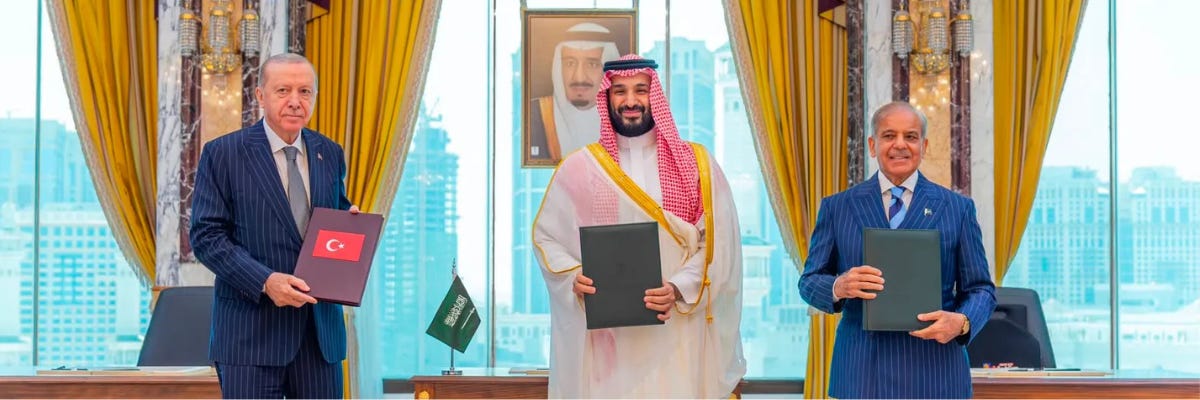
Nearly a decade later, amid a regional war, the idea of an Arab NATO has given way to a multiethnic NATO, bringing together Arabs, Turks, and Pakistanis through the Makkah Joint Defense Agreement signed on 7 August. Its central provision is very NATO-like. The pact stipulates that an armed attack against one of the three states will be regarded as an attack against all. The agreement is intended to strengthen collective deterrence and deepen defense cooperation and will have an institutional structure, including a ministerial committee and a permanent secretariat in Saudi Arabia.
Geography makes certain interpretations of the pact almost inevitable. Turkiye sits to Iran’s northwest, Pakistan to its east, and Saudi Arabia across the Persian Gulf to its southwest, and all three are Sunni-majority states. At a time when Iran remains at the center of a regional war, the emergence of an Arab-Turkish-Pakistani collective-defense arrangement can easily be presented as the anti-Iran alliance that MESA never managed to become. But that reading may be too narrow.
Unlike many earlier attempts at regional collective security, the exclusion of a specific regional player has not been built into the agreement as its organizing principle, and this distinction matters. The three governments themselves have refrained from defining the agreement as either a Sunni bloc or an alliance directed against Iran. Turkish Foreign Minister Hakan Fidan has explicitly said that it is not aimed at Iran or any other country. More importantly, he has said that the intention is not for the arrangement to remain limited to its three founding members. Recent reports suggest Iran was encouraged to endorse the Makkah Agreement by its founding members, but it has not yet formally done so.
Broadening Frameworks
The most immediate pathway for expansion is already visible through the R4—Saudi Arabia, Turkiye, Pakistan, and Egypt. The four countries have increasingly coordinated their regional diplomacy during the current conflict, not as a military grouping but as a diplomatic one. All four have direct security interests in the conflict, but they have also emerged as intermediaries capable of maintaining channels with different sides.
Pakistan has become a critical channel between Iran and the United States and has hosted and facilitated contacts between the two sides, including the negotiations leading to the Islamabad MoU. Turkiye has maintained intensive diplomatic and backchannel contacts with Iran, the United States, and the GCC states throughout the conflict and has reportedly stopped a ground invasion of Iran. Egypt had already assumed a more active role on the Iranian nuclear file before the war, particularly since the September 2025 Cairo agreement between Iran and the International Atomic Energy Agency.
On 5 August, just two days before the Makkah Agreement was signed, the four R4 foreign ministers held their fifth meeting since March. They called for continued diplomatic efforts and de-escalation, emphasized freedom of navigation through the Strait of Hormuz and Bab al-Mandab, and discussed strengthening and institutionalizing their coordination.
The overlap between these two arrangements is significant. Three members of the R4 are now also members of a collective-defense agreement, while the fourth, Egypt, has already been publicly identified as a possible future participant. While there is a heated debate as to why Egypt did not sign on to this pact in August, the same geopolitical tensions that prevented it create a political and diplomatic layer around the new defense arrangement that could facilitate its expansion.
The fact that the other GCC states are not among the initial signatories should also not be interpreted as their exclusion from this process. Oman and Qatar have been directly involved in mediation throughout the conflict and continue to play important roles in negotiations involving Iran and the United States. Bahrain, meanwhile, has publicly welcomed the Makkah Agreement and described it as an addition to the wider regional defense architecture that complements existing GCC collective-defense mechanisms.
The UAE is the more consequential case. It is simply too economically, militarily, and strategically important to remain outside any serious regional security architecture. Saudi Arabia and the UAE have developed increasingly visible differences over Yemen, Sudan, the Horn of Africa, and regional economic competition. But despite the tensions, they also remain deeply interconnected across security, economic, and political affairs. The UAE’s absence from the Makkah Agreement should therefore not automatically be interpreted as another Saudi-Emirati rupture. But it does raise an important question about where the agreement goes next.
If Saudi Arabia develops one security network with Turkiye and Pakistan while the UAE builds another around its own partnerships, particularly with Israel and India, and Iran remains tied to its own network of regional partners and proxies, the region could simply end up with another collection of competing blocs. That would reproduce the same fragmentation that has undermined previous attempts to establish a regional security framework. On the other hand, if the Makkah Agreement is designed as an expandable platform, the partnerships of individual countries could eventually become bridges into a broader architecture.
A wider architecture would have to work on a different basis as it cannot require countries to abandon their existing partnerships before joining a regional framework. Turkiye will remain a NATO member. Saudi Arabia and the other GCC states will continue to maintain extensive security relationships with the United States and European countries. The UAE, as well as Bahrain, will continue to develop its relationships with India and Israel. Pakistan will maintain its own strategic partnerships. The purpose of a regional architecture should not be to replace these relationships, but to establish common rules between regional states despite them.
The inclusion of Turkiye, Pakistan, and potentially Egypt also expands the scope of the discussion beyond the Gulf. For much of the past decade, proposals for regional dialogue have focused primarily on a GCC+2 format comprising the six GCC states, Iran, and Iraq. That remains an important foundation, particularly for matters directly affecting the Persian Gulf. But the current conflict has demonstrated the limitations of treating Gulf security in isolation from developments in the broader region.
The war has also accelerated a longer-term reassessment of the US role in Gulf security. Washington remains the principal external security partner for the GCC states, but it is increasingly viewed as an indispensable partner rather than a sufficient security guarantor, particularly after a war in which the Gulf states were exposed to direct Iranian attacks and even extensive US military deployments and defense systems could not fully protect their territories and critical infrastructure. This has strengthened the case for diversifying security partnerships and developing regional mechanisms that do not depend on Washington alone.
Saudi Arabia, as the convener of the agreement, and its post-war strategy of expanding its security and diplomatic relationships with other major regional states could therefore help widen the scope of dialogue. Egypt, Turkiye, and Pakistan each bring relationships, interests, and channels that differ considerably from those of the GCC states and their participation could also help break some of the deadlocks that have repeatedly constrained direct Arab-Iranian security dialogue.
Keeping the Door Open
Any regional system built permanently around containing Iran will produce Iranian counter-alliances and counter-deterrence rather than regional security. The experience of recent years, culminating in the current conflict, have made that clear. Iran cannot be removed from the geography of the region and will remain one of the largest states bordering the Persian Gulf, a major military power, and an important economic and political actor regardless of the nature of its government or the state of its relations with its neighbors.
At the same time, it would be unrealistic to imagine Iran simply joining the Makkah Agreement as it currently stands. Tehran is not going to enter a collective-defense structure under which an attack against Saudi Arabia, Turkiye, or Pakistan would automatically be treated as an attack against Iran. Cairo did not make this commitment within the newly established grouping either. The fact is that they do not need to.
A regional security architecture does not have to consist of a single military alliance containing every country. It can develop through concentric arrangements and the Makkah Agreement could remain an inner collective-defense arrangement between states prepared to make stronger military commitments to one another. Around it, a wider non-aggression and regional-security framework could gradually emerge involving Egypt, the other five GCC states, Iran, Iraq, and eventually other regional players, including Jordan, Lebanon, and Syria.
Europe provides an imperfect but useful precedent for such concentric arrangements. NATO has remained the collective-defense core for its members, while wider institutions and mechanisms have allowed countries outside the alliance to participate in broader systems of security cooperation, confidence-building, and non-aggression. The Helsinki process was built precisely on the understanding that competing alliances did not first have to disappear for adversaries to agree on rules governing their conduct toward one another. Tehran, Cairo, or Abu Dhabi would not have to join the Makkah defense pact to become part of the regional security architecture, just as states historically did not need to join NATO to participate in the broader European security order.
A regional security architecture does not have to consist of a single military alliance containing every country. It can develop through concentric arrangements.
The commitment would be different from the Makkah Agreement and an attack on one would not be an attack on all. Instead, the participating countries would commit not to attack one another, not to allow their territory to be used to launch attacks against another participating state, not to target civilian infrastructure, and not to disrupt the shared economic lifelines on which the region depends. Over time, such a framework could also address more difficult issues such as missile and drone deployments and other military activities that are particularly vulnerable to miscalculation.
If the objective is a genuine regional security architecture, the process cannot stop at either the Iranian or Israeli border. A system permanently designed to exclude Iran will fail, but so will one permanently designed to counter Israel. The eventual endpoint has to be an arrangement in which all regional states are bound by basic rules of non-aggression and regional conduct.
This is obviously not an immediate prospect. It could take a decade, two decades, or longer, and different countries would enter different parts of the architecture at different stages. But if the agreement remains an exclusive military alliance, it will become one more bloc in a region already full of them. On the other hand, the Makkah Agreement could become a whole new story by placing a military arrangement at the center without formally defining a regional state as the enemy, alongside a broader diplomatic mechanism that is already engaging competing sides.
Mehran Haghirian is the Executive Director of Research and Programs at the Bourse & Bazaar Foundation.