
By Nader Habibi
Iranian government officials have openly admitted that U.S. and Israeli war has caused severe damage to the Iranian economy. In addition to the destruction of many industrial and manufacturing units by airstrikes, an intrusive naval blockade has also caused major disruptions to Iranian supply chains. While Iranian economy was already suffering under maximum pressure economic and financial sanctions even before the 2026 war, the unprecedented direct conflict has resulted in a sharp increase in inflation, poverty, and food insecurity for large segments of the population.
There is evidence that addressing these hardships and preventing shortages of food and other essential commodities is a top priority for the government. Yet, instead of introducing a comprehensive and effective rationing system—a step commonly taken in countries facing major wars, including in Iran itself during the long Iran-Iraq war—the government has focused on managing the supply of these essentials without significantly interfering in market prices. The current policies include a digital voucher cash payment system (called “Kalabarg”), a monthly per-capita income support transfer, and a collection of price subsidies for fuel, electricity, and some food items. While these measures have offered some economic relief, they fall short of providing adequate minimum economic security under the current war conditions.
The Iranian government’s hesitation to introduce policies consistent with full wartime economic mobilization, incuding rationing and price controls, is puzzling. Involvement in a major war typically forces governments to make difficult choices about the allocation of scarce economic resources, leveraging mechanisms including price controls and the rationing of basic household necessities such as food and fuel. During World War II, for example, the United States, the United Kingdom, Germany, Japan and many other countries imposed strict rationing to manage their respective war economies.
The scale of economic warfare and military strikes that Iran has faced in 2026, is easily comparable to what it faced during the 1980-88 Iran-Iraq war and perhaps, even more severe. In several stages of the ongoing 2026 war the US and Israel expanded their targets far beyond the military structures to include basic industries such as steel, and petrochemicals; and critical infrastructure such as roads, railways, bridges and commercial ports. The impact of these operations on Iran’s economy has been visible in the severe loss of economic activity and sharp price increases for many products and services. Yet Iran has not switched from its ongoing system of price subsidies and digital voucher payments toward a more comprehensive wartime system of administrative allocation and rationing.
Programs Before the War
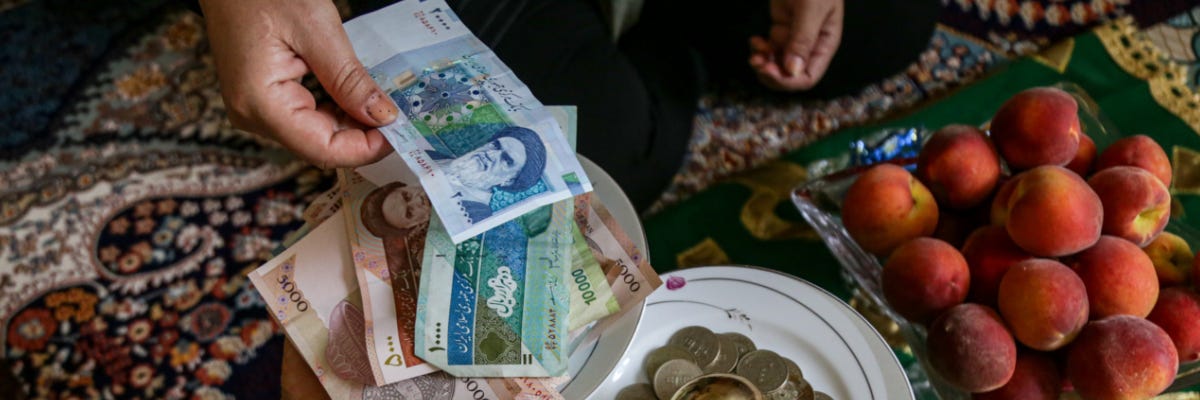
When the war began in January 2026, Iran had already introduced the Kalabarg digital voucher mechanism, depositing a fixed amount of credit per capita to the accounts of qualified households. The households then used this digital credit for purchase of specific necessities, which included eleven essential products such as rice, red meat, poultry, sugar and cooking oil. In addition to this monthly voucher the government also offers a monthly unrestricted cash payment (in the form of direct bank deposits) which has a much smaller nominal value than the voucher. As of August 2026, the monthly value of Kalabarg voucher was IRR 10,000,000 per month and the highest level of the monthly unrestricted cash payment was IRR 4,000,000.
When we compare these payments to the cost of goods and services, they are very small in real purchasing power. Summed together the exchange value of these direct per capita payments (IRR 14,000,000) is equivalent to $8 per month at the free market exchange rate. Since prices of some food items in Iran are lower than those in advanced countries, the purchasing power of this payment could be considered equivalent to $20. But even this monthly amount is negligible compared to the cost of living and only covers a small portion of the cost of basic food items. The main reason for this disparity is that there are no price control mechanisms and while the annual inflation rate has increased to near 100% in 2026, the nominal value of income support and the Kalabarg voucher have not been adjusted to keep up with inflation.
Iran also has a system of price subsidies for several energy products such as fuel, natural gas, and electricity, as well as traditional basic breads, which were introduced even before the 1979 Islamic Revolution. While these subsidies make the price of energy more affordable for low-income households, they also disproportionately benefit the middle- and upper-class households that own cars and large houses. Such transfers are inefficient and put a heavy fiscal burden on government annual budget.
While these inefficient subsidies and the small cash and voucher payments can be effective in more peaceful and “normal” conditions, they can hardly be considered sufficient during periods of intense conflict such as what Iran is currently experiencing. Their insufficiency is demonstrated by the multiple reports of mass poverty and unaffordability of many necessities for large segments of the population in recent months. What is even more surprising is that policymakers in the Islamic Republic have extensive experience with rationing mechanisms. Iran introduced a comprehensive coupon-based rationing system and price controls for several basic commodities in 1981 (a few months after start of the Iran-Iraq War). This system continued well into 2000s before it was formally replaced by a system of targeted income-subsidies in December 2010. In light of this familiarity and extensive administrative experience, the reluctance of the government to introduce a similar rationing system during the current conflict is puzzling.
Explaining the Puzzle
The lack of government intervention has not gone unnoticed, and there has been a growing debate around subsidy reforms and supply management in recent months. In response to open calls in Iran’s financial press for a return to a modern, digital version of rationing, agriculture minister Gholamreza Nouri announced on June 20th that the government had no plan to introduce a comprehensive rationing system. He argued that the current system of free market adjustments and the Kalabarg digital coupon for food products is sufficient and insisted that the country’s food supply is well managed. While rejecting the proposals for rationing however, the government has embraced other mechanisms to make sure an adequate supply of basic commodities remains available in stores. Still, while there has been no visible shortage of food items in Iran, prices are so high that most families cannot afford the minimum recommended consumption of protein, dairy, and vegetables.
There are several explanations for the reluctance of Iranian government to initiate full wartime economic mobilization and quantity-based rationing. First, the sudden loss of a large number of top leaders including the supreme leader Ali Khamenei, who was killed by a U.S.-Israeli airstrike in February, has reduced the governance capability of the government to day-to-day management of the war and economic crisis. It is possible that in this emergency mood, the government officials have little time left to initiate a significant institutional shift for introducing a comprehensive rationing system.
Second, this inability to focus on large-scale economic plans can also be partly a result of the factional disagreements in the top leadership of the ruling elite in recent months. One faction is strongly opposed to negotiations with the U.S. because of lack of trust in Trump administration, and confidence in Iran’s ability to withstand the pressure. Another faction, which includes President Masoud Pezeshkian and the parliament speaker Mohamad Bagher Ghalibaf, is more concerned about the economic hardship on the civilian population. These factional competitions and lack of coordination among various centers of power, could have also made it more difficult for the government to undertake a large-scale transition to a rationing system.
Third, the gray nature of the current Iran war, which involves periodic oscillations between negotiations and military strikes can also be a contributing factor. The repeated cycles of negotiation-military strike-negotiation have created disagreements about how long the conflict will last, and hence the need for full scale economic mobilization. Some Iranian leaders believe that Iran’s ability to disrupt shipping in the Strait of Hormuz has given Iran a leverage that will force the U.S. to accept a negotiated settlement, which will include an end to the naval blockade and a reduction of sanctions. Some Iranian leaders evidently believe that the war will be won soon and there is no need for a comprehensive rationing system, which would undermine the partial deregulation and price liberalization reforms of the past two decades.
Finally, the shortage of resources and supplies for offering adequate rations of basic commodities can also be a factor in the government’s reluctance to adopt a comprehensive rationing system. The current combination of monthly digital Kalabarg vouchers and digital cash payments amount to monetary payments and the government can reduce the real fiscal burden of these payments by borrowing from the central bank, which in turn can cover the fiscal deficit by printing money. This approach also avoids reductions in the defense budget and the selective direct and indirect fiscal support for loyal supporters of the regime. This approach reduces the need to devote substantial real resources to the income support program—real resources which might require a reduction in the defense budget or the fiscal resources that are allocated to the loyal supporters of the regime
This continued dependence on cash transfers enables the government to fund the monthly payments but it has resulted in record high inflation rates and a decline in real purchasing power of these income supports. Hence there is a steady decline in the effective economic security that the program is expected to provide for the households. Switching to an effective rationing system requires adequate procurement and distribution of food items and other necessities—it is easier for Iranian authorities to monetize budget deficits than it is for the operationalization of a new rationing system under the conditions of war, sanctions, and the naval blockade.
The Islamic Republic faced considerable discontent and protests in late 2025 and January 2026. It responded to these mass protests with overwhelming force in January. According to a report by OHCHR approximately 16,000 to 20,000 people were killed by regime security forces during the protests. This massive crackdown ended the mobilization—the state is now more confident that it can use violence to handle any new mass protests that might be spurred by economic hardship.
Furthermore, to demonstrate its resolve against domestic opponents the regime has brought its supported on the streets in many corners of major cities for nightly pro-government gatherings. Consequently, some Iranian policymakers believe that the political and security cost of declining economic conditions are manageable. This calculation may also have played a role in lack of full economic mobilization (price control and rationing) despite deteriorating economic conditions for large segments of the population. This calculation, however, might also be shortsighted. If millions of households suffer from inadequate access to food, medicine, and transportation for a long period of time, their predicament can ultimately lead to political instability and even undermine the regime’s military strength.
Economic rationing and administrative allocation of resources cause many inefficiencies and challenges in both planning and implementation, but in times of severe disruption to normal economic activity, such as what Iran is currently experiencing, such measures can be effective tools for providing minimum economic and food security for all citizens. So far, the Iranian government’s approach has proven inadequate to protect the welfare of ordinary Iranians, who will remain under acute pressure so long as the current war continues.
Nader Habibi is the Henry J. Leir Professor of Practice in the Economics of the Middle East at Brandeis University.