
By Arya Kia
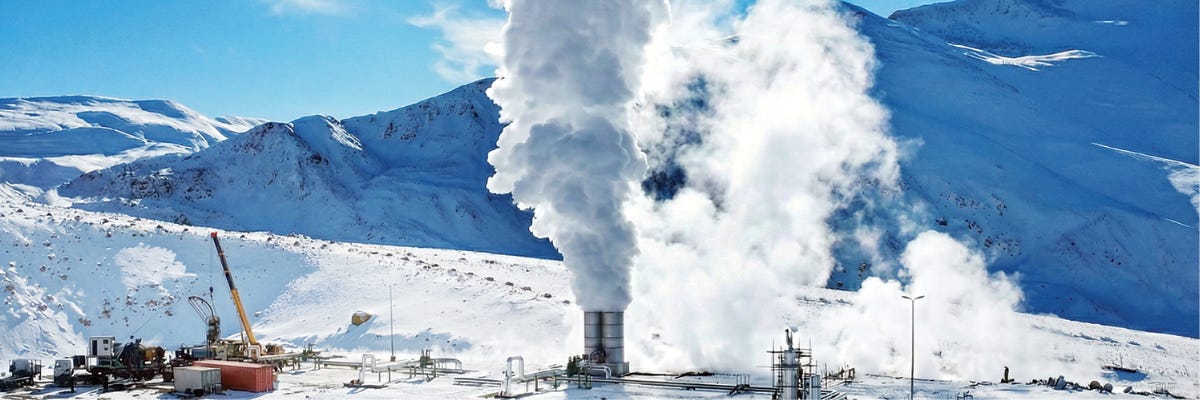
On 22 July, Iran connected its first geothermal power plant to the national grid. Located near Meshginshahr on the slopes of Mount Sabalan in Ardabil Province, the facility has an installed capacity of 5.4 MW. Against an electricity system generating hundreds of terawatt-hours annually and facing shortages measured in gigawatts, its immediate contribution to the grid will be almost imperceptible.
Yet measuring the project only by its initial output misses its significance. The Sabalan plant represents Iran’s first attempt to produce continuous renewable electricity from underground heat. It also tests whether capabilities developed in Iran’s oil, gas, and power industries—including deep drilling, reservoir engineering, steam systems and turbine commissioning—can be transferred to an energy technology that reduces fossil-fuel consumption rather than expanding it.
The project is therefore a technical achievement. It shows that Iran can complete a complex geothermal project under difficult geographic and geopolitical conditions. But it also took decades to bring the modest Meshginshahr plant online—an indication that contractual, financial, institutional, and technological barriers could prevent geothermal power from developing in Iran beyond this first symbolic project.
Geothermal Potential
The Sabalan Geothermal Power Plant was commissioned for the state-owned Thermal Power Plants Holding Company, which functions under Iran’s Ministry of Energy. MAPNA Group’s Power Plant Services Company supervised the plant’s commissioning and grid synchronization. Iranian oil-service companies have also contributed to repairing and cleaning geothermal wells.
The plant sits at an elevation of approximately 2,700 meters, around 25 kilometers south of Meshginshahr. Several wells have been drilled to depths of approximately 3,000 meters to access the high-temperature reservoir beneath Mount Sabalan. Iranian reporting places reservoir-fluid temperatures at approximately 240°C to 270°C, although temperatures vary by well and measurement location.
The facility reportedly uses a single-flash generation system. In this configuration, high-pressure geothermal fluid is brought to the surface and depressurized, causing part of the fluid to turn into steam. The steam drives a turbine and generator, while the separated liquid must be managed and, ideally, reinjected to help maintain reservoir pressure and limit environmental impacts.
The process avoids burning fuel at the power plant, but it is not technically simple. Geothermal fluids can contain dissolved minerals, salts and gases that produce scaling and corrosion in wells, pipes and plant equipment. The Sabalan fluid’s chemistry reportedly creates risks of mineral deposition and chloride-related corrosion, requiring resistant materials, chemical treatment and continuous monitoring. Sustainable expansion will also depend on balancing production and reinjection so that reservoir pressure and temperature do not decline prematurely.
Iran’s energy minister described the project as requiring EUR 10 million in investment. However, a late-2025 project update reported that more than 650 billion tomans (approximately EUR 3 million at the contemporary free-market exchange rate) had already been spent on construction, drilling, well cleaning and rehabilitation. These figures may cover different project phases, use different exchange rates or apply different accounting boundaries. The safest conclusion is that EUR 10 million is the government’s announced project figure, but the plant’s full historical cost remains unclear.
Delayed Delivery
Iran began investigating geothermal resources in the 1970s. Mount Sabalan was identified as a priority area during work conducted in the 1990s, and detailed studies were later undertaken with international technical participation. Plans for a pilot power plant were publicly discussed more than a decade ago, followed by repeated projections that it would enter operation in 2013, 2015, 2021 and 2022.
Part of the delay is explained by the project’s physical location. Heavy snowfall, blizzards, icy roads, and severe winter temperatures restrict access to the site and shorten the annual construction season. Transporting heavy equipment to a remote site at high altitude also complicated construction and operations. MAPNA has characterized the plant as one of Iran’s most geographically and climatically challenging power projects.
But difficult geography does not explain the entire delay. In 2019, a parliamentary representative from Meshginshahr identified weak contractor performance, unsuitable contract terms, and the contractor’s limited financial capacity as major causes. An executive of the Thermal Power Plants Holding Company acknowledged shortcomings by the Ministry of Energy, while the contractor attributed delays partly to disagreements over the interpretation of the contract and unresolved financing.
The project also encountered a common problem in geothermal development: expenditure must occur before the quality and commercial productivity of the resource are fully known. Solar developers can assess irradiation with relatively inexpensive measurements and add capacity module by module. Geothermal developers must finance geological surveys and expensive exploratory wells before knowing whether the reservoir will provide sufficient temperature, pressure and fluid flow.
Sanctions amplified these risks, especially considering that MAPNA is designated under U.S. sanctions authorities. The designation restricted access to foreign finance, international contractors, specialized equipment, banking systems, software and high-performance materials. Currency depreciation made imported components more expensive and created uncertainty for contracts extending over several years. A recent peer-reviewed assessment of Iran’s energy transition concludes that sanctions have constrained renewable development by restricting capital, technology transfers, and participation in international climate-finance mechanisms.
However, attributing every delay to sanctions would be misleading. Iran’s heavily subsidized fossil-fuel prices, inconsistent renewable policy, institutional fragmentation, payment risks, and uncertain conditions for private investors have also weakened the economic case for investment in green power generation, limiting the degree to with authorities have prioritized projects like the Meshginshahr plant.
Transformative Potential
Iran possesses some of the world’s largest natural-gas reserves, but underground abundance has not guaranteed reliable electricity supply. According to the U.S. Energy Information Administration, natural gas accounted for approximately 85% of Iranian electricity generation in 2022, while oil supplied another 8%. Fossil fuels therefore generated approximately 93% of the country’s electricity.
This dependence creates several vulnerabilities. Gas demand rises sharply during winter as households require heating, forcing competition between residential consumption, industry and power generation. During supply shortages, some power plants switch to diesel or fuel oil, increasing costs and air pollution. In summer, high electricity demand, inefficient equipment, aging infrastructure and insufficient investment contribute to power shortages and forced restrictions on industry.
Geothermal power offers something that solar and wind cannot provide alone: continuous, weather-independent renewable generation. It can operate overnight, during cloudy weather and when winds are weak. It does not inherently require batteries or fossil-fuel backup to maintain output through daily weather cycles.
Geothermal is not the only type of firm renewable energy—hydropower, biomass, and some forms of stored renewable energy can also provide controllable output. However, Iran’s hydropower fleet is increasingly exposed to drought and declining water availability, while biomass resources remain limited. This makes geothermal particularly relevant as a complement to solar and wind in Iran.
At an illustrative 90% capacity factor, a 5.4 MW plant could generate approximately 43 gigawatt-hours per year. That is only around 0.012% of Iran’s 2022 electricity generation. Depending on the efficiency of the gas-fired plant displaced, that output might save roughly 9 million to 11 million cubic metres of natural gas annually. These estimates show both sides of the project: it is insignificant at the national scale today, but each dependable geothermal megawatt can replace more fossil generation annually than a megawatt of variable renewable capacity.
Comparative Advantage
Iran has genuine advantages in geothermal development. Decades of oil and gas production have created domestic experience in deep drilling, well completion, geophysical analysis, reservoir modeling, high-pressure fluid handling, and the operation of steam turbines. Companies such as MAPNA have demonstrated substantial capabilities in power-plant engineering and turbine services. Existing drilling and petroleum-service companies can undertake at least some of the work that would otherwise require foreign contractors.
These capabilities may give Iran an advantage over countries that possess geothermal resources but lack a mature subsurface industry. Developing geothermal projects could also help redirect oil-sector expertise towards lower-carbon energy without requiring an entirely new technical workforce.
The transfer is not automatic, however. A geothermal reservoir is not an oil or gas field. Its commercial value depends on the sustainable circulation of heat and fluid rather than the extraction of a finite hydrocarbon stock. Developers must understand thermal recharge, fracture systems, mineral chemistry, reinjection behavior, and pressure decline. Geothermal wells also expose equipment to high temperatures, corrosive fluids, and scaling conditions that differ from many petroleum applications.
Some specialized turbines, control systems, downhole instruments, corrosion-resistant alloys, and chemical-treatment technologies may remain difficult or expensive to obtain under sanctions. Iran may be able to manufacture or adapt a growing share of this equipment domestically, but localization claims should be evaluated through operating performance over several years.
Geothermal is also generally more difficult and slower to initiate than solar power. Developing a geothermal field requires resource exploration, expensive drilling and confirmation that a reservoir can sustain commercial production before much of the investment can begin earning a return; conventional projects can therefore require development periods of several years. Solar PV, by contrast, is modular and can be deployed at scales ranging from individual rooftops to large utility projects. This helps explain why Iran’s renewable expansion is currently dominated by photovoltaics.
Official data reported in May 2026 indicate that operational renewable capacity had exceeded 3,165 MW, with solar accounting for 60% and wind for 29%. Iran’s Seventh Development Plan originally targeted 12 GW of renewable capacity by 2028, while SATBA’s longer-term vision calls for 30 GW by 2031; the current government has since promoted an even more ambitious 30 GW expansion program.
Untapped Potential
Iran’s geology includes volcanic zones, extensive fault systems, hot springs and tectonically active regions. A peer-reviewed review identified at least 18 promising geothermal zones, including Sabalan in the northwest, Mahallat in central Iran, and the Makran region in the southeast. Approximately 9% of the territory examined in earlier resource assessments was classified as having geothermal potential.
But resource potential must be distinguished from commercially proven capacity. Officials say the Sabalan reservoir could ultimately support 250 MW and that wells already drilled may support approximately 30 MW. Academic studies have presented several different estimates. Earlier development plans discussed around 50 MW, while a detailed numerical reservoir model estimated approximately 31 MW as a best production case under its assumptions and suggested that as much as 114 MW might be sustained over 70 years under a larger development scenario.
These estimates do not necessarily contradict one another because they measure different concepts. The 250 MW figure may describe the wider heat resource. The 30 MW figure concerns the productive capacity associated with existing wells. The modelling studies estimate sustainable electricity output under assumptions about well placement, fluid flow, pressure decline and reinjection. The next credible milestone is whether the first unit can maintain reliable output and whether additional wells can support expansion to approximately 25–30 MW without unacceptable reservoir decline or maintenance costs.
There may also be a stronger economic case for using geothermal heat directly. After electricity generation, remaining heat can potentially serve district-heating networks, greenhouses, aquaculture, food drying, industrial processes, and spas and tourism facilities. Research has previously proposed cascading uses around Meshginshahr, where heat would be applied sequentially at progressively lower temperatures.
Such applications could create visible local benefits: lower heating costs, year-round agricultural production, employment and expanded tourism. They could also improve total project economics by extracting more useful energy from each well. The regional-development dimension may ultimately matter more to local communities than the small amount of electricity sold to the national grid.
Wartime Significance
The timing of the Meshginshahr plant’s grid connection gives the project political significance. In recent years, Iran has faced recurring electricity shortages, industrial power restrictions, and mounting pressure on its energy system. The ongoing U.S. and Israeli war on Iran has also drawn greater attention to the vulnerability of power plants, fuel infrastructure, transmission networks, and other concentrated energy assets.
In this environment, the Meshginshahr plant exemplifies technological self-reliance. Iran has completed a first-of-a-kind renewable project despite sanctions, difficult terrain, financing constraints, and repeated delays. More importantly, the plant illustrates that energy security is not simply a matter of producing more natural gas. A more resilient electricity system requires greater diversity in fuels, technologies, locations, and scales of generation.
At 5.4 MW, the Meshginshahr plant is far too small to materially improve national energy security or alter Iran’s electricity balance. The project has yet to demonstrate that geothermal power can attract sustained investment, operate reliably over the long term, expand economically or overcome the institutional and financial weaknesses that contributed to its prolonged development. But the plant’s significance could become clearer over the next several years.
If it achieves benchmarks in capacity factor, maintenance requirements, reservoir performance, gas savings and local economic benefits, the new plant will prove that firm renewable power can become part of Iran’s energy portfolio. For now, it is an isolated engineering achievement. But in an isolated country like Iran, such small achievements offer great hope.
Arya Kia is an energy systems researcher focusing on renewable energy, energy and water systems, energy policy, and system dynamics. He is a doctoral candidate in Energy Systems Engineering at Sharif University of Technology and is based in Vancouver, Canada.