By Matthew MacGeoch
“We have concluded contracts for around 80 gigawatts of solar,” said Iran’s President Masoud Pezeshkian, in December 2025 when asked about his proudest achievement in his first year in office. The figure demands a moment’s attention. Iran’s entire electricity system has about 101 GW of nominal generating capacity. In 2026, the UK has around 22GW of solar capacity, with policy targets to reach 45 GW by 2030. Pezeshkian’s an 80 GW would exceed that ambition by almost three-quarters.
Only a fraction exists. Iran’s renewable energy agency, SATBA, said in August 2026 the country had about 5.8 GW of operating renewable capacity, including 5.3 GW of solar. Pezeshkian has subsequently set a target of 30 GW within two years.
The word “contracts” also deserves a footnote. Iranian officials have used the 80GW figure to refer interchangeably to applications, permits, memoranda, and contracted projects. Much of it lacks finance, equipment, land, or a firm grid connection. While there is a large development pipeline, the country does not yet have a 80GW construction program.
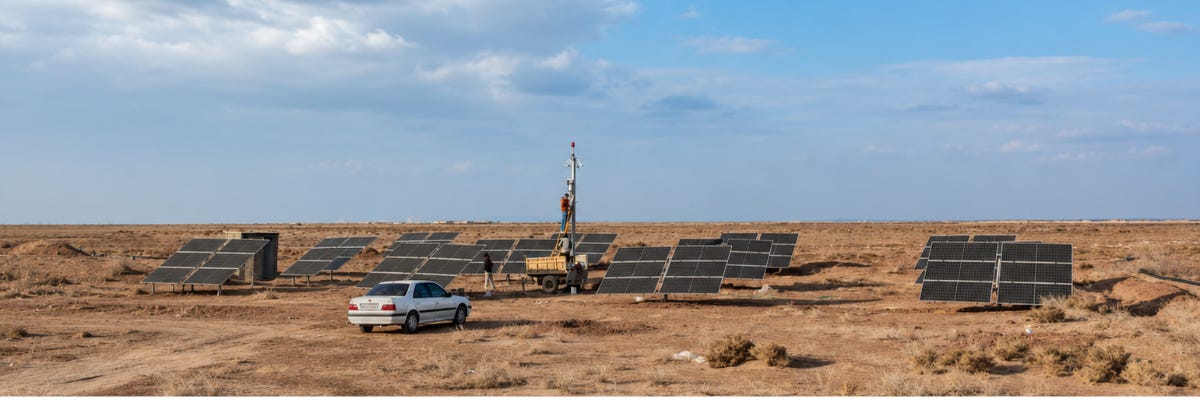
The acceleration remains striking nonetheless. Solar capacity has risen from about 0.7 GW to 5.3 GW in two years, according to SATBA. Even allowing for inconsistent reporting, panels are appearing faster than new thermal plants. Iran’s solar push has become an energy-security program, driven by a power system that can no longer supply reliable, cheap electricity from the country’s abundant hydrocarbons.
Power Shortage Costs
Iran’s electricity deficit can literally be smelt. To meet winter demand spikes, some power stations turn to mazut, a heavy fuel rich in sulphur and other pollutants. In November 2024, Pezeshkian’s government stopped three plants from burning it near Arak, Isfahan, and Karaj. Power cuts followed for two hours.
The choice was plain and stark. Burn dirtier fuel or switch off parts of the country. Winter outages interrupted lifts, traffic lights, shops, and heating systems. Summer brings its own challenges. During the 2025 heatwave, officials closed banks and government offices to suppress demand. Households endured scheduled cuts as temperatures in some parts of the country passed 50°C.
Factories face the same shortage, at great cost. Alireza Kolahi-Samadi, the head of the Industry Commission of the Tehran Chamber of Commerce, put it plainly: “Electricity is like blood for industry.” He said some plants lost the equivalent of ten working days each month. One medium-sized company reportedly suffered losses above 13 billion tomans, roughly $60,000.
Diesel generators are a costly substitute. In some industrial zones, managers have reported buying black market fuel at several multiples the official price. The regulated electricity tariff then becomes a poor guide to the cost of power. The relevant price is the cost of an interrupted shift.
That calculation explains why Iranian industry is a natural home for solar build-out. A manufacturer that installs panels gains some control over daytime supply. Its savings include electricity purchases, diesel consumption, spoiled output and hours of production recovered.
Need for Solar
Iran generated 94% of its electricity from fossil fuels in 2025, including 90% from natural gas. It holds the world’s second-largest proven gas reserves. But power stations compete for these reserves together with household heating, petrochemical plants, industry, oilfield re-injection, and exports. Seasonal storage remains limited, with residential demand for gas rising sharply in winter, and electricity demand peaking in summer. As Arya Kia explains in his series on Iran’s electricity crisis, fuel shortages and other constraints limit how much electricity Iran’s power plants can reliably supply, while electricity underpricing encourages consumption and weakens investment in the system.
In summer 2024, demand approached 80 GW while available supply stood around 62 GW, according to an Iranian parliamentary assessment. The resulting gap of almost 18 GW explains why a system with nearly 100 GW of nominal capacity could not keep the lights on.
Iran also flared about 30 billion cubic meters of gas in 2025, more than any other country barring Russia, and up by 50% from five years ago. Some power stations lacked gas while elsewhere it was burnt into the air. The contradiction reflects weak collection infrastructure, limited investment, and sanctions that obstruct equipment and finance.
Solar addresses the part of the shortage that comes with the sun. Iranian officials have estimated that cooling equipment accounts for more than 35 GW of summer electricity demand. Air conditioners in Iran alone can draw more power than the entire British solar fleet can produce at noon.
Photovoltaic generation matches this nicely. Output rises during hot bright afternoons, when cooling demand strains the system; and to compound its timing advantage, solar plants can be built faster than gas, hydro, or nuclear projects.
Drought sharpens both sides of this problem. Iran’s meteorological agency reported rainfall 40% lower than the long-term average in 2025, amidst a 5-year drought. Lower reservoir levels reduce output from Iran’s 12 GW+ hydroelectric fleet. Hotter weather simultaneously raises cooling demand.
Solar uses little water during operation and produces the most during dry summers. It therefore serves Iran’s power system long before any climate or carbon benefit.
Law-Made Market
Iran has created renewable demand through legislation, as well as necessity. Article 16 of the Knowledge-Based Production Leap Law applies to all industrial energy consumers with demand above 1MW (0.001 GW). They must source 1% of their electricity from renewables in 2022, rising to 5% by 2027.
Companies can build their own plants, buy renewable electricity through bilateral contracts, or purchase it on the national green electricity exchange. Those who fall short pay for their missing share through the renewable tariff instead. The regulation itself therefore combines a purchase obligation, a penalty, and several routes to compliance.
This resembles renewable policies globally. Renewable obligations required utilities or large consumers to purchase a specified share. Article 16 borrows this and gives it a domestic, industrious motive: factories need dependable power.
The policy has developed with little connection to international climate diplomacy. While Iran signed the Paris Agreement in 2016, it is yet to ratify it. Its renewable program receives almost no support from Western governments, development banks, or international investors.
The law also redistributes energy security. Large companies finance and build solar farms, trade green electricity, and secure some protection from outages.
Reliance on China
The build-out of solar sits between state directive and private delivery. The government allocates land, issues permits, sets tariffs, and channels finance through the National Development Fund. Private developers, industrial companies, and state-linked conglomerates build and operate many of the plants.
But the state can’t really finance the development pipeline itself. Sanctions, plummeting oil revenues, and the ever-shrinking rial, constrain public spending. Aside from the war cutting Iranian oil exports by 85%, the government’s 1405 (2026-27) budget proposed a nominal spending increase in public resources and expenditure of 5%, set against 40% inflation, meaning a real term contraction in government investment by about 25%.
The National Development Fund can supply up to 80% of qualifying project investment, with developers contributing the rest. Valuably, import costs are processed through the state exchange platform, subsidizing currency risk. By August 2026, the central bank said that $1.7 billion had been allocated for renewable projects.
Yet industrial self-generation remains low. Mohsen Tarztalab, the Deputy Minister of SATBA said that “many industries have not moved in this direction, and so are subject to load management”, continuing to say that if these sectors don’t comply with this obligation, the Ministry will be “more strict with supplying them next year”.
Strong-arming industrial solar generation is a firmer economic model. A steelworks that consumes its own solar power relies less on a state buyer and earns its returns through avoided outages, fuel purchases, and grid changes. Article 16 mandates this model, while the minister’s statements provide reinforcement.
Sanctions do not make panels and inverters easy to obtain, as they restrict banking, insurance, shipping, and access to foreign currency. Most panels come from China, whose manufacturers dominate global solar production and remain willing to serve the Iranian market, or did, until the advent of war.
Today, Iran’s domestic manufacturing base can supply just 0.7 GW of equipment. For tomorrow, Tehran is trying to build a panel industry. In September 2026, citing an 8-fold increase in import expenses, SATBA promised guaranteed purchases for 2 GW qualifying Iranian panels, and public lending and financing for companies willing to manufacture them. An October call for investors sought proposals for new and expanded manufacturing capacity.
The program starts with assembly. Imported cells and other components can be put together in Iran, with the domestic share intended to rise over time. Domestic factories may eventually reduce the import bill, but Chinese hardware will likely still supply this solar rush.
Meanwhile, Chinese industry media have reported that panels for the Iranian National Development Fund are funded through an oil-for-solar arrangement, using Iranian crude revenues in China to pay for solar hardware. A piece of policy any climate minister in any other country can only have wished for.
China gives Iran access to standardized, modular, and quick-to-install equipment. But the arrangement also concentrates supply-chain and financial dependence on one relationship.
Pakistan’s Warning
Pakistan has shown how quickly private solar can grow when unreliable electricity meets affordable Chinese hardware. In 2025 alone it imported 18 GW of Chinese panels, making it the world’s second-largest importer, with cumulative imports exceeding 50 GW by September 2025.
Households, farms, and businesses supplied most of the capital. A Pakistani think tank estimated that citizen-led solar mobilized $18 billion over nine years, including $5 billion in 2025 alone. Much of this equipment sits off-grid, beyond the conventional utility planning system.
Iran shares several ingredients with Pakistan. Both countries have unreliable grids, constrained public finances, depreciating currencies, and access to inexpensive Chinese panels. In both, consumers increasingly view solar as protection, or relief, from the power system.
But they also differ. Pakistan’s expansion grew largely from households, farms, and commercial users responding to high prices and favorable net metering. Iran still subsidizes grid electricity heavily and places more emphasis on industrial mandates, state-directed finance, and utility-scale projects. Sanctions of course, as well as war, complicate payments and logistics.
Iran is also seeking to expand household solar. A rooftop solar program from the Ministry of Energy targets 550,000 residential systems, backed by low-interest loans and a network of pre-approved installation companies.
But Pakistan’s experience also points to a risk Iran could eventually face. Customers able to finance solar can reduce their electricity bill. Yet the network’s fixed costs remain, and so this puts pressure on utilities to raise tariffs for those without solar, including households unable to afford solar. Pakistan’s already indebted power system now wrestles with this.
Iran appears far from that point, for its primary issue is scarcity. Over time, Article 16 and industrial self-generation can add capacity without needing the treasury to subsidize every project. But the country’s grid will still need tariffs that pay for transmission, backup power, and evening supply. Solar can leave the grid weaker if regulators treat those services as free.
The 80 GW figure remains a statement of ambition for sun-rich Iran. Just like the energy transition everywhere else, finance, currency, equipment, grid connections, and stable revenue determine how much ambition becomes electricity. Even a smaller build-out, though, reflects a change in how the oil and gas giant, Iran, seeks to secure its power supply.
Nor will solar power repair every weakness in Iran’s energy system. Increasingly, however, it will give households, companies, and even the state a measure of autonomy from those weaknesses. For a nomadic family, a steel plant, or a sanctioned gas giant, that autonomy is another name for energy security.
Matthew MacGeoch is a Senior Associate at Systemiq, where he works on sustainable finance and climate policy. He previously served as a policy fellow at the Bourse & Bazaar Foundation, contributing to the Rihla Initiative for Green Economic Growth. At the Climate Bonds Initiative, he led work on sustainability-linked bonds and researched transition plans for hard-to-abate industries. He has also worked at the UN Department of Economic and Social Affairs.
Section: (vision-iran-initiative) Photo: ISNA