By Hossein Hamdieh
The Trump administration’s war against Iran may well be intended to lead the country down the path to dilapidation and economic ruin. Now that Washington’s project of toppling Iran’s political system has proven far messier than anticipated, it looks as though the country is being dragged into a war of attrition, with military attacks punctuating the ongoing pressure of sanctions and a naval blockade.
Faced with this outlook, one would expect Iranian entrepreneurs and businesses to exercise increased caution, focusing on retrenchment and reduced expenditure rather than expansion and investment. Surely, desperate times justify desperate measures. In some Iranian sectors, however, we are witnessing the opposite instinct.
Amid the destruction and uncertainty of a year marked by war, a striking confidence seems to be blossoming among Iranian artificial intelligence (AI) entrepreneurs as they expand their businesses and launch new projects. Some are already thinking of a post-war Iran, encouraged, perhaps in part, by the resilience the country has shown in the face of nuclear-armed adversaries. Their determination raises a question that extends beyond the fortunes of any single business: can technological innovation help a country weather the pressures of war and prolonged economic isolation, or will those same pressures eventually exhaust its capacity to innovate?
The AI Innovation Factory (AIIF) is one example of this forward-thinking push towards innovation in Iran. Its development began after last summer’s 12-Day War with Israel, and the initiative has expanded since the outbreak of the wider war involving the U.S. with backing from domestic venture capital firms and several of Iran’s leading private businesses, including Digikala, Alibaba, and Cobel Darou.
To understand AIIF’s significance, one must consider Iran’s troubled history with industrialization and its struggle to keep pace with successive industrial revolutions. Although the country developed a substantial industrial base during the 1960s and 1970s, much of that growth depended on oil revenues, imported machinery, and foreign technology. The third industrial revolution, typified by the widespread adoption of information and communication technologies, began in the 1980s just as Iran was engulfed by revolution, nationalization, and a devastating eight-year war with Iraq. While much of the world advanced into electronics, computing, and automation, Iran struggled to preserve and rebuild what it had already achieved.
Economic development began to ramp up again in the 1990s, when Iran rebuilt its industrial capacity and expanded its universities, engineering expertise, and telecommunications. Despite its late start, Iran quickly caught up with global digital trends. During the optimistic years surrounding the 2015 Iran nuclear deal, an earlier iteration of the Innovation Factory and similar projects helped foster a generation of ambitious technology entrepreneurs for whom building a successful company suddenly seemed within reach. E-commerce flourished, creating jobs both for skilled tech workers and blue-collar workers in logistics, warehousing, and delivery.
The 2018 reimposition of U.S. sanctions under President Donald Trump dealt a heavy blow to these prospects. As economic insecurity and inflation eroded living standards, the costs were borne by businesses and social classes alike. This experience exposed a persistent vulnerability in Iran: entrepreneurial ambition alone cannot sustain development when access to capital, technology, and international markets remains precarious.
AI for Industry
AI may now change some of these calculations. For a country whose participation in major technological transformations has repeatedly been delayed or disrupted by war, sanctions, and political upheaval, AI offers a chance to enter the new era of change on different terms. It could help modernize existing industries, improve productivity, and reduce waste without requiring entirely new industrial infrastructure. It also lowers the barriers to entrepreneurship, allowing small teams to develop products, test ideas, and launch businesses with less time and capital. For a country with a large pool of engineers and technically educated young people, this could be particularly significant.
Moreover, years of sanctions have increased the importance of efficient operations across Iranian industries. Companies are forced to do more with less—finding ways to reduce costs and make better use of limited resources has become essential to their survival. In this context, AI could play a considerable role, especially if young entrepreneurs can apply their technical skills to the practical problems facing established industries.
This is precisely the connection AIIF is attempting to make. Its model brings together three elements that too often remain fragmented: industry, talent, and capital. Rather than treating AI as a separate technology sector, the Factory seeks to bring it into the productive economy.
Its approach reverses the familiar startup model in which entrepreneurs develop a technology and then search for customers. Instead, AIIF begins by negotiating with industrial firms to identify problems they need solving. These are collected and assessed according to their potential to become the basis of a commercially viable startup. At the same time, the Factory recruits technically skilled entrepreneurs from across the country, assembling teams capable of developing solutions. Venture capital then provides the resources needed to turn promising ideas into businesses whose products can eventually be sold beyond their initial industrial clients. The starting point, in other words, is not a technology product in search of a market, but an industrial problem in search of a solution.
Growing Enthusiasm
AI has already generated renewed enthusiasm among Iranian entrepreneurs, even as the broader startup ecosystem struggles. According to the Iranian Venture Capital Association, more than $235 million was invested through venture capital contracts in 2024. Preliminary estimates for the following year suggest a sharp decline in traditional private venture capital investment, while corporate venture capital, backed by established businesses, continued to grow. For some of Iran’s larger private firms, investing in technology is more than a bet on future growth—it is a way of adapting to sanctions, rising costs, and limited access to foreign technology.
The numbers suggest that something is stirring. According to Sharif University’s 2025 Iran AI Index, around 27% of surveyed Iranian businesses had adopted AI, while the country’s AI market was estimated at $90 million. The excitement is also visible in the labor market. JobVision, one of Iran’s largest recruitment platforms, reported that demand for AI specialists had increased two-and-a-half-fold between 2021 and 2025, with vacancies rising by 33% in autumn 2025 compared with the previous year.
Yet, this growing appetite has not been matched by adequate investment. Venture capital funding for Iranian AI companies amounted to an estimated $6.6 million in 2024–25, while three-quarters of businesses using AI had spent less than IRR 20 billion (about $15,000) on the technology over three years.
There is, in other words, something of an AI fever in Iran, but one that has yet to translate into substantial investment or industrial transformation. While there is no shortage of talent and ambition among Iranian entrepreneurs, what remains scarce is the capital, infrastructure, and connections to established industries needed to turn this enthusiasm into viable business opportunities.
The Day After
This is where economic resilience becomes more of a necessity than an abstraction. Iran’s entrepreneurs are not operating in conditions conducive to technological development. War, sanctions, disrupted international connections, and economic uncertainty impose formidable constraints on their ambitions. Yet these same pressures have made the search for more efficient ways of producing, organizing, and doing business increasingly urgent. For established industries, technological investment may no longer be simply a matter of preparing for the future, but of surviving the present.
With its industrial ambitions long constrained by external dependence and domestic instability, Iran could find in AI something beyond the prospect of technological advancement: a means of strengthening economic resilience. By using technology to help industries adapt, entrepreneurs can more readily grow and businesses can more efficiently use increasingly scarce resources, allowing Iran to weather the storm without surrendering its ambitions for the future.
Innovation cannot replace diplomacy, nor can economic development flourish indefinitely under conditions of war. But Iran’s AI push can help build the foundations upon which recovery and future growth depend until a viable diplomatic solution emerges. The significance of initiatives such as AIIF lies in refusing to allow Iran’s future to be held hostage to its present predicament. Even amid the destruction of war, Iranian entrepreneurs are already building their country for the day after.
Hossein Hamdieh is a social researcher based in Tehran and co-founder of Borj Space, a think tank, exhibition space, and public forum exploring development in Iran and the Global South. He holds a joint PhD in Geography and Anthropology from King’s College London and Humboldt University of Berlin. His research focuses on informal labor markets, urban poverty, and working-class communities in the Middle East.
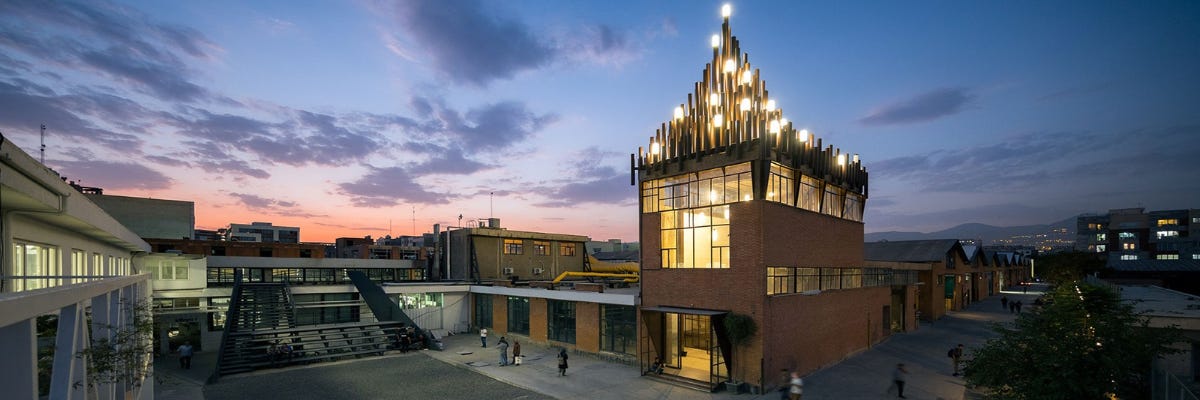
Section: (vision-iran-initiative) Photo: Diba Tensile Structures