
Dear Colleague,
Among the most important aspects of our work at the Bourse & Bazaar Foundation are our convenings and events. Through our initiatives, we make a special effort to bring together unique combinations of people, bridging regional divides and breaking down academic and policy silos.
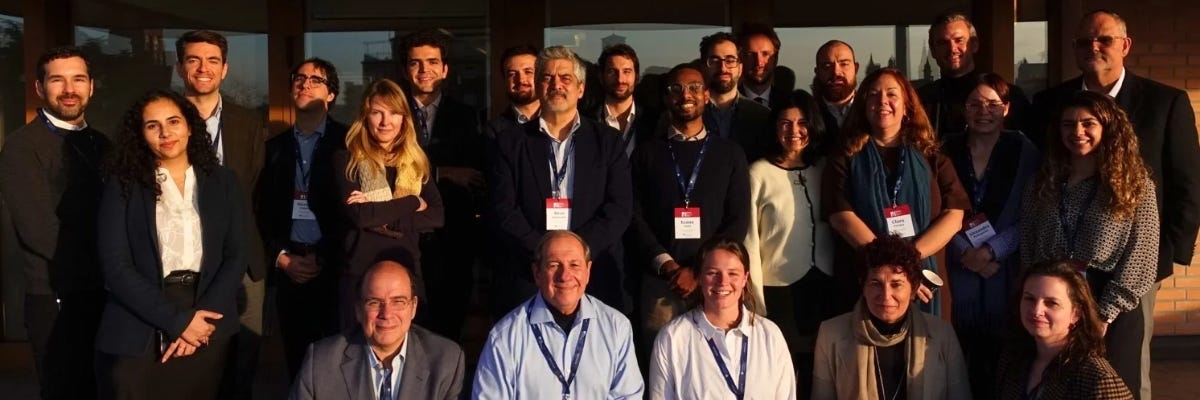
This is especially true of our Bologna Initiative for Sanctions Relief, which launched in 2025. Last week, the initiative brought together 25 leading sanctions experts at Johns Hopkins SAIS Europe in Bologna, Italy for a three-day conference focused on efforts to make sanctions more effective and humane.
Think tank events can often feel like they are part of a circuit, bringing together the same people for the same conversations, just in different places. While regular engagements with peers can be fruitful, we feel that it is especially important to ensure that those working on policy issues have an opportunity to engage counterparts they would not normally have the opportunity to meet. In such settings, individuals from different institutional backgrounds can find common ground, creating the conditions necessary for policy reform.
Please click the headings below to learn more about our latest activities.
Best regards,
Layla Saghafian
Engagement Coordinator
Leading experts gathered in Bologna to discuss how sanctions can be made more effective and humane.
As part of the Bologna Initiative for Sanctions Relief, the Bourse & Bazaar Foundation convened 25 leading sanctions experts at Johns Hopkins SAIS Europe for a three-day conference where participants discussed practical ways for sanctions to achieve their policy goals while reducing harm to civilians. During round tables and breakout sessions, participants discussed the macro- and micro-level impacts of sanctions in countries including Venezuela, Cuba, Iran, Russia, and Syria. The group, which included both sanctions researchers and practitioners, as well as current and former government officials, also discussed joint research projects that will form the basis of the initiative’s activities in 2027. This research is published on a dedicated platform called The Sanctions Age. The conference was led by Josefine Petrick, with support from Francesco Schiavi and interns Prachi Adhikari and Aaditya Subramanian.
U.S. economic pressure on Iran has counterintuitively empowered Iranian elites and created an oligarchic class.
Speaking with Thanassis Cambanis and Rohan Advani on the Order From Ashes podcast, which is produced by the Center for International Policy in Washington, D.C., Esfandyar Batmanghelidj discussed the many counterproductive effects of U.S. sanctions targeting the Iranian economy. While sanctions have weakened the central government’s fiscal position, Esfandyar noted that quasi-state actors, including, but not limited to, the IRGC, have begun to grab a stronger hold on Iran’s economy. In the face of rising inflation and high unemployment, many companies have been able to repress wages, contributing to a loss in income for ordinary households. Large exporters are also holding their foreign currency revenues abroad as the Iranian rial depreciates daily, despite their legal obligation to repatriate those funds through Iran’s centralized foreign exchange market. Through such effects, while most firms are worse off in absolute terms, certain large enterprises and the elites who control them have gained a larger relative portion of Iran’s national wealth.
Upcoming Events
From the ICC to Latin America: The Human Cost of U.S. Sanctions
December 3 - Webinar
The Bologna Initiative on Sanctions Relief is partnering with the Charity & Security Network to hold a joint closed-door roundtable titled “From the ICC to Latin America: The Human Cost of U.S. Sanctions.”
This year has seen a deeply concerning increase in U.S. economic sanctions, from Cuba to the International Criminal Court. Even after sanctions have been eased or removed entirely, their consequences can linger long after the restrictions are lifted.
The event will bring together researchers, economists, human rights advocates, and civil society and nonprofit leaders to examine the human costs of U.S. sanctions, question their effectiveness as an instrument of foreign policy, and explore opportunities for collective advocacy, policy reform, and greater accountability.
Two members of the initiative, Hana Attia of Georgetown University in Qatar and Michael Galant of CEPR, are featured speakers in the roundtable.
Risky Business? Financial Exclusion, Humanitarian Action & Sanctions
December 8 - Hybrid
For a second event delivered in partnership with Charity & Security Network, this hybrid discussion will convene UN experts, Member States, financial-sector representatives, and civil society leaders to examine the financial impacts and chilling effects of economic sanctions on humanitarian action.
Despite important advances under UN Security Council Resolutions 2664 and 2761 and the FATF’s revised Recommendation 6, humanitarian and civil society organizations continue to face financial exclusion, de-risking, and barriers to accessing essential banking services. This discussion will explore the gap between international humanitarian safeguards and their domestic implementation, highlighting practical recommendations for governments, regulators, and financial institutions to strengthen humanitarian financial access.
Thank you for engaging with our work. If you would like to share content from the Bourse & Bazaar Foundation with a friend or colleague, please click the button below: