
By Anna Jordanová
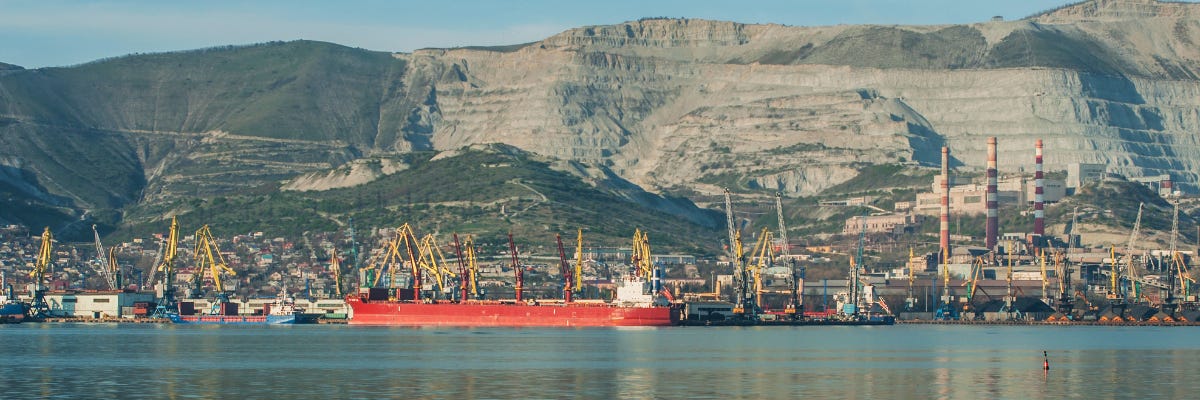
On July 30, two tankers transferring oil from Russia’s Novorossiysk terminal through the Black Sea were hit by Ukrainian drones, adding to five earlier incidents that month. The vessels sustained limited damage, but the attacks deepened concerns conflict was spilling over into vital trade corridors.
Decades of infrastructure investment have stitched the Caspian Sea and Black Sea into a single transportation and energy corridor, linking East and West. Transit through the so-called “Middle Corridor” has emerged as an important alternative route for the delivery of both Central Asian energy and Chinese goods to Europe. This corridor, which avoids the sanctions pitfalls of logistics networks that pass through Russia and the Middle East, is also an economic and diplomatic lifeline for the states of Central Asia and the South Caucasus.
The “Middle Corridor,” officially known as the Trans-Caspian International Trade Route (TITR), has expanded significantly in recent years. The corridor is especially important for Uzbekistan and Kazakhstan, the two largest and fastest growing Central Asian economies.
Today, the corridor facilitates not just goods trade, but also green energy production, rare earths mining projects, financial services, and many other instances of trans-regional cooperation. Growth in the utilization of the corridor has been driven by new investment and policy reforms. Efforts are under way to improve legal harmonization and digitalization to speed up cross-border transit, while port and transport capacities are also being expanded.
Caspian littoral states are also expanding their merchant fleets, increasing capacity in the corridor while reducing dependence on Russian vessels. Turkmenistan has launched one new vessel this year and a second is under construction. Kazakhstan has announced plans to add six more ships. Azerbaijan, already boasting the largest Caspian fleet, is also promising further expansion. On the back of such investments, cargo volumes quintupled between 2018 and 2025, reaching just over 4 million tons per year.
Encroaching Conflict
Despite the strong commercial incentives for further investment, the development of the corridor linking the Caspian Sea and Black Sea is under threat due to encroaching conflict. According to data compiled by ACLED, more than 100 UAV attacks or sabotage incidents have been recorded in the Russian coastal areas of the Caspian Sea since 2025.
Kazakhstan, although far away from the Russian-Ukrainian frontlines, has reported more than a dozen cases of UAVs drifting into its territory since last year. Uncertainty also arises from the south, where the Iran war continues. A recent Ukrainian missile strike on an Iranian vessel traveling north in the Caspian Sea, allegedly carrying weapons from Iran to Russia, highlighted the risk that the two wars could merge.
Proximity to conflict zones is a growing challenge for countries across the Caspian region, especially given numerous chokepoints in key energy and transportation networks. The attacks on the Black Sea tankers were of particular concern for Kazakhstan, the largest and wealthiest Central Asian state. Around 80% of the country’s oil exports are routed through the Caspian Pipeline Consortium (CPC) pipeline, which originates at the Tengiz oil field and terminates at the Novorossiysk terminal. The attacks led to a pause in oil loadings at Novorossiysk. Loadings resumed in early August, but overall volumes fell 20% in July. A more protracted pause in loadings could impact production at the Tengiz fields.
Kazakhstan’s longstanding multivector foreign policy was crafted to help the country avoid getting embroiled in conflicts. By threatening no other states, it hoped not to be threatened in return. But this approach has proven insufficient to shield the country from collateral damage from the Russian-Ukrainian conflict.
Given the risks posed by Ukraine’s increasing targeting of Russian energy assets, it is understandable that Kazakh President Kassym-Jomart Tokayev recently urged Vladimir Putin to freeze military operations in Ukraine as soon as possible. On the other side of the battlelines, American Vice President JD Vance asked Ukrainian President Volodymyr Zelenskyy to halt the attacks on tankers loading at Novorossiysk—a reflection of the fact that American oil majors Chevron and ExxonMobile are the majority owners of the Tengiz field.
Much like how Gulf oil producers are dependent on the Strait of Hormuz, Kazakhstan is dependent on the CPC. Other routes, such as the Kazakhstan-China pipeline or the oil terminal in Batumi, Georgia, are either too distant from key customers or lack the necessary capacity. Just as its energy flows pass through Russian territory, so too does most of Kazakhstan’s goods trade. While the Middle Corridor has struggled to process more than 5 million tons of cargo, the so-called Northern Corridor, which utilized Russia’s railway network, processes nearly 20 times that cargo volume each year.
Uncertain Horizon
Despite diplomatic momentum and substantial infrastructure investment, the long-term horizon for the Middle Corridor remains unclear. Europe and China have strong economic motives to support the corridor, while Central Asian states continue to seek connectivity solutions to reduce dependence on Russia, especially as southern routes through Iran and Afghanistan remain unreliable. For now, Russia has tolerated the expansion of the Middle Corridor—the corridor’s good trade remains modest and energy exports continue to flow through Russian territory.
But the geopolitical pressures are mounting. Ukraine seems determined to continue defending itself at all costs; and even if Kyiv does not intend to target non‑Russian infrastructure around the Caspian and Black Seas, repeated incidents are changing the risk landscape for commercial operators. Trade through the Middle Corridor may become more expensive, more volatile, and more difficult to manage. There are also other challenges to consider, such as climate change. The Caspian Sea is shrinking and falling water levels are threatening port operations.
For Central Asia and the South Caucasus, the Caspian and Black Seas are an arena for trade, diplomatic relevance, and broader engagement with the world. Ultimately, while major powers shape the strategic environment, it is the regional states that must keep their shared corridor operating day-to-day and while safeguarding long-term viability. Their ability to do so will be a major test of diplomatic capacity and multivector foreign policies. The states of Central Asia and the South Caucasus will strive to remain economically connected without being drawn into the conflicts surrounding them.
Anna Jordanová is a former visiting fellow at Bourse & Bazaar Foundation. Her research examines Central Asian regional dynamics, regime security strategies, and relations with the West.