
By Francesco Salesio Schiavi
When the Strait of Hormuz effectively shut to normal maritime traffic at the outset of the U.S.-Iran war in late February of this year, Middle East oil producers scrambled to find alternative trade routes. Oil producers that already had bypass infrastructure in place, such as Saudi Arabia with its pipeline to the Red Sea port of Yanbu or the UAE with its Habshan-Fujairah pipeline, adapted the fastest. Pipelines, however, can only move energy products. When it comes to bulk and container trade, encompassing economic mainstays such as food, fertilizer, machinery, and consumer goods, new solutions were needed. Regional countries turned to a long ignored mode of trade—trucking. Six months on, with no clear resolution to the Hormuz standoff in sight, trucking has emerged as a new and likely permanent layer of the transport infrastructure in the Middle East.
Across the region, demand for trucks has surged as port operators and liners rely on truck freight to establish new intermodal transport corridors. UAE hauler Trukker reported a 30% rise in full-truckload shipments between February and March as demand for truck freight surged. Another UAE firm, Ramool Transportation, announced that it had earned more in March alone than in all of 2025, a sign of how sharply rates have risen for operators able to put trucks on the road.
At Khor Fakkan, a container port on Sharjah’s Indian Ocean coast that used to handle little more than transshipment traffic, truck movements rose from just 100 vehicles per day before the war to roughly 8,500 by the end of July. In turn, weekly container throughput rose from about 8,000 to 65,000 TEU. The port’s operator, Gulftainer, hired more than 900 staff within a fortnight to cope and later committed $2 billion to lift annual capacity toward 10 million TEU within three years, accelerating development plans in response to the crisis.
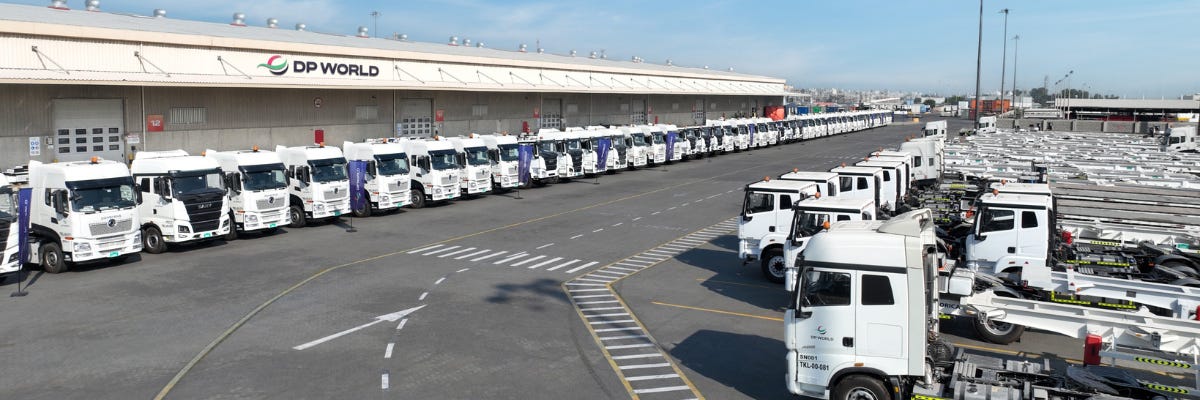
DP World, the world’s largest port operator, is reportedly planning a multibillion-dollar investment to expand capacity at the Port of Fujairah, after activity at its flagship Jebel Ali port fell more than 90% during the initial weeks of the war. The company also acquired 700 new trucks in July to increase freight capacity. These trucks now carry containers from Fujairah roughly 250 kilometers through the Hajar Mountains to Dubai and Abu Dhabi, reducing operational dependence on transits through the Strait of Hormuz.
Global liners have also begun adjust routes to connect with the new truck freight corridors. Maersk has added land legs linking Khor Fakkan and Fujairah to the rest of the UAE and MSC has launched a multimodal service that uses trucks to forward containers across Saudi Arabia towards the Jeddah and King Abdullah ports. In June, CMA CGM announced a $400 million joint venture with Oman’s Asyad Group for the construction of a new terminal at Sohar as part of a second land-bridge to the UAE.
An increase in truck traffic extending east from Saudi Arabia’s Route 95, running through the Shaybah oilfield to Oman’s Ramlet Khelah crossing, has cut transit time between the two countries by 16 hours. Truck freight has become the main channel for Saudi-Omani trade, with the value of goods crossing there nearly tripling to $830 million within one month of the Iran war.
Earlier this month, Oman’s Arkan Logistics and Saudi Arabia’s SPARK Logistics signed an agreement formalize the route as a “Secure Green Land Corridor,” though neither side has disclosed target volumes or a timeline for operationalization. Meanwhile, Saudi Arabian Mining Company expanded its truck fleet from 600 to 3,500 vehicles in the early stages of the war to ensure a reliable flow of fertilizer to Red Sea ports.
In Iraq, tanker trucks have emerged as a vital lifeline for the country’s oil industry. Reducing loadings as the Basra terminals, which normally account for more than 90% of Iraq’s oil flow, has depressed export revenue. To compensate for these disruptions, Iraqi authorities established a new corridor through Syria, routing an estimated 2.1 million tonnes of fuel oil overland to the port of Baniyas since April via two reopened border crossings, under a plan initially set at 500,000 tonnes a month. Baniyas now unloads roughly 900 tanker trucks daily. The overland route is costly, but has allowed Iraq to maintain oil exports to customers in Spain, Egypt, and the United States, among others. The new route has also boosted customs revenue for Syria, with direct receipts estimated to have reached $25 million since April.
Overcoming Limits
The rapid expansion in truck freight across the region is coming up against commercial, infrastructural, political, and geographic limits. Commercial operators describe a persistent shortage of trucks and drivers as the main constraint, one they expect higher freight rates to spur investment in larger fleets.
Underinvestment in truck-related infrastructure has also created capacity constraints. Customs depots, weigh stations, rest stops, and warehouses are struggling to handle the surge in truck traffic. In Iraq, a lack of truck-loading facilities at the country’s southern oil fields continues to cap how much crude can be transported overland.
The increased movement of Emirati, Saudi, Omani, Iraqi, Syrian, and Turkish truckers through the region represents a new form of cultural encounter and exchange, stitching together countries that have long been disintegrated.
Political difficulties have also emerged. Since July, trucks crossing from the UAE into Saudi Arabia at the Al Batha border post have faced extensive delays with drivers reportedly sleeping under their trailers while cargo, ranging from building materials to fresh flowers, sits in customs limbo. Traders blame tensions between the Gulf’s two largest economies. Historically, low levels of intra-regional trade meant that customs harmonization and the administration of border crossings were not a political priority for Middle Eastern countries, undermining coordination during the recent crisis.
Finally, geography will limit the extent to which truck freight can compensate for the traditional maritime routes through the Strait of Hormuz. Westward routes from Fujairah, Khor Fakkan, and Sohar through Oman, the UAE, Saudi Arabia, and beyond are confronted by the vast Rub al-Khali desert, also known as the “Empty Quarter.” Moreover, because Iran’s coastline sits so close to these ports, insurers and carriers continue to treat the new routes as exposed to Iranian attacks. During the war, Iran has hit structures or vessels at all three ports.
Transformative Potential
While the shift to overland trade may face inherent limits, it will nonetheless prove transformative for the Gulf and the wider Middle East. As parallel can be drawn to the rise of European trucking in the years following the Second World War.
Postwar Europe’s shift from rail freight to road freight helped physically connect national markets in a way fixed rail corridors alone had not, as trucks began crossing onto the Mediterranean corridor linking Spain to Hungary, moving along the Rhine-Alpine axis between Rotterdam and northern Italy, and over the Brenner Pass on the Scandinavian-Mediterranean corridor. The increased dependence on truck freight led to the establishment of the European Union’s TEN-T road network in 1996, just three years after the formal establishment of the union.
But aside from political or infrastructural connections, the shift towards trucking also helped create cultural ties across the European continent. The movement of tens of thousands of trucks also meant that tens of thousands of drivers of different European nationalities traveled through countries they would never otherwise have visited. While the parallel is inexact, the increased movement of Emirati, Saudi, Omani, Iraqi, Syrian, and Turkish truckers through the region represents a new form of cultural encounter and exchange, stitching together countries that have long been disintegrated.
The Strait of Hormuz is likely to stay central to global energy flows for years and trucking will never suffice to reduce the dependence of Middle Eastern economies on maritime trade. But trucking has emerged as a transformative new layer of the region’s transport infrastructure and with it has come new avenues for economic, political, and cultural integration.
Francesco Schiavi is an Associate Fellow at the Bourse & Bazaar Foundation. He is an international relations specialist focused on security, defense, and governance in the Levant and the Gulf.