By Henna Moussavi
From more than 4,000 kilometers away, Tehran arrives as a man’s voice heard through a pair of headphones. The speaker, referred to here as Nima, is a civil servant working extended shifts in the middle of an unprecedented aerial bombardment, observing how a city of millions absorbs active conflict and is altered by it.
Internet access in Iran was severed on the first day of the war, and those contacting foreign entities still risk prosecution. Nima used a VPN without certainty it would hold. “I was a bit hesitant,” he says, “mainly because these VPNs aren’t reliable… so I thought I should say this now, and you can listen whenever you’re able.” The recordings reflect a kind of precarity, while the background noise of music and traffic serves as a reminder that life in the city continues.
Walking through a city responding to destruction, he recorded several hours of voice notes during long hours on the job, with the rhythm of someone thinking out loud. His reflections trace fractures in public opinion, the destruction of infrastructure, and the informal systems that emerge to fill gaps left by the state.
Informal Resilience
One of the more striking features of Nima’s testimony is his description of how Tehran residents had to improvise in the absence of functioning state services. “During the Iran-Iraq war, there were clear air raid sirens. People knew when to go to shelters. There was a recognisable system. In this war, that hasn’t really existed,” he explained, as the defence infrastructure that would enable early warning was largely damaged at the outset of the war. In their place, with roots in the 12-Day War in June, an informal system has emerged.
“People themselves have effectively created an informal warning network,” Nima explains. When someone hears fighter jets overhead, they message their contacts, and those contacts message theirs. On domestic platforms—Bale, Eitaa, Soroush, Rubika, or specialised Telegram channels like RahBandoon—people post real-time notices, ensuring that “information spreads quickly between people and across different areas.” A message may warn about jets over northern Isfahan, another about airstrikes Mazandaran, and others with updates from Tehran. While people can still be nervous to confide in and openly message on these public forums, they have been invaluable resources in the absence of better warning systems.
Many users make attempts to infer trajectory and timing based on observation, estimating where a strike might land and how many minutes remain. This has become particularly important due to the evidence that U.S. and Israeli forces have conducted double-tap strikes, putting aid workers and residents trying to help others at severe risk.
A population experienced in navigating institutional failure has learned to replace reliance on state broadcasts with lateral communication, led by an instinct to protect their fellow citizens. “This, to me, is one of the more striking aspects of what’s happening,” Nima said with some pride.
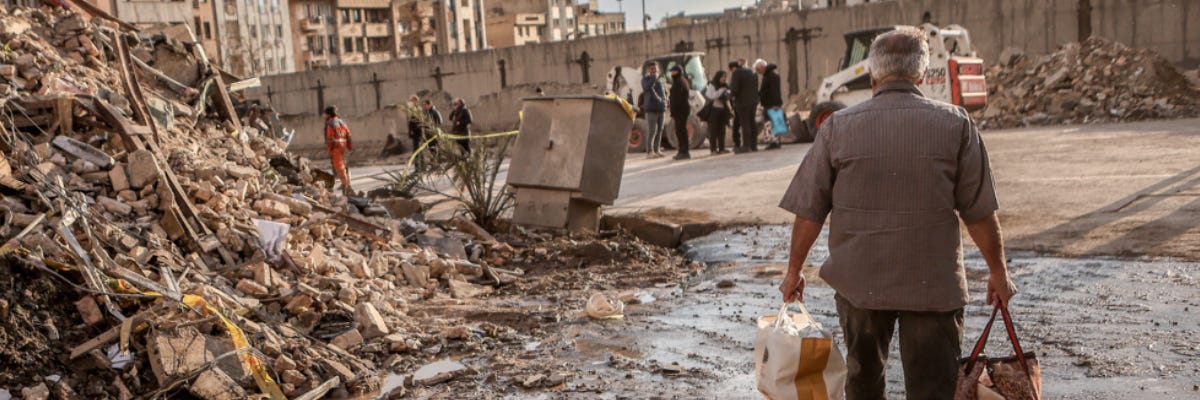
When residential buildings are hit by airstrikes, the damage is rarely limited to a single address. The impacts are felt throughout neighbourhoods, where residents are quite literally left to pick up the pieces. Neighbors are evacuated and belongings need moving from high floors, quickly.
Volunteer groups have appeared to help search and rescue and cleanup efforts. Some volunteer groups are religious, others are secular. Many travelled from other cities to help in Tehran specifically, due to the disproportionate number of strikes in the capital. “This kind of work requires a large amount of manpower, which naturally cannot be fully provided by government administrative structures. “ As they clear glass from stairwells, carry furniture down ten-storey blocks, and pack the remaining possessions of people whose homes have been damaged.
Divided Communities
Beyond these examples of community resilience, Nima is quick to acknowledge the division of perspectives among his friends, family, and colleagues, not just with regards to the conflict, but in confrontation with the Islamic Republic on the whole. He describes three groups.
There are those who support the Islamic Republic and interpret the war as an existential struggle, one that demands loyalty and national unity to sustain their ideological mission of anti-Western and anti-imperial sentiment. There are others who reject the government and, in this case, saw external pressure as a necessary, if uneasy, means of forcing regime change. And then there is a third group, distinct from the latter: individuals who are openly opposed to the Islamic Republic but remain equally resistant to foreign intervention, driven by a deep scepticism that any external power carrying out military action against their country could genuinely be acting in their interest.
As Nima described the situation in Tehran while I followed headlines from afar, it became clear that his observations reflected a kind of equanimity that one achieves through proximity to hardship and devastation.
A defining feature of the third camp is how it recognizes that whatever the outcome of this conflict, whether a ceasefire is upheld or not, ordinary Iranians will bear the cost. They anticipate that, in the aftermath of the war, the Islamic Republic will only emerge more repressive, using the war as justification to tighten control over all aspects of social and political life in Iran. This has become more apparent with continued executions, arrests, and restrictions on internet access and other public freedoms, which have been even more aggressive since 28 February.
The different groups have been visible during the war. “Almost every night there have been gatherings in streets and alleys that would normally be empty, it feels like the whole city is involved,” Nima explains. These gatherings included pro-government rallies and quietly defiant New Year celebrations, where dissent is felt, if not openly expressed. Sometimes dissent was heard, if not seen, as in the case of slogans chanted from apartment buildings, celebrating the death of the Supreme Leader Ali Khamenei.
But in the midst of war, political sentiments became even more complicated. “Even among people who were critical of the government, I heard something quite striking: if they noticed anything suspicious, especially given concerns about internal incidents, they would report it,” Nima explained. “Some people said they had never done such a thing before, but during that period they even called official numbers, like those of the intelligence services, to report suspicious activity.”
Likewise, when U.S. President Donald Trump warned that “an entire civilization” would die if Iran did not yield to U.S. demands, many Iranians were dismayed by the indiscriminate nature of the threat. “There was less visible effort, even rhetorically, to distinguish between the government and the population,” Nima noted.
When imagining Iran’s future, public imagination appears to oscillate between two poles: North Korea, a country home to an entrenched authoritarian regime, and Libya, a country that has collapsed into lawlessness and disorder.
“Overall, there’s a feeling of uncertainty,” he states, “people are trying to adapt, but no one really knows what’s coming.” If understanding Iran’s political trajectory is challenging from afar, Nima’s account suggests that the same uncertainty, disagreement, and contestation persist within the country itself. Even the boundaries between the three camps Nima identified at the outset of the conflict have begun to blur, as ideas and allegiances shift between them and individuals reassess their positions in light of the war’s personal impact on their lives. What emerges is not a singular public mood, but a society negotiating its divisions in real time, under the pressure of conflict.
Wartime Routines
With the way events have unravelled, “many people are pessimistic,” Nima concludes. “They don’t think the aftermath of the war will improve things. Economically, the damage could take years to repair. There’s a general sense that even when it ends, life won’t return to normal quickly.” But he is also able to reflect the spirit Iranians have been able to sustain during the war, laughing to himself as he recalls the moment Tehran’s residents suspected the water might be cut off—the first priority for his friends and family was “taking a shower.”
Nima sounds unsure about the ceasefire and the high-level talks between the U.S. and Iran. “It’s not clear how serious or advanced these talks are, or how willing each side is to make concessions. Past experience hasn’t been very encouraging, and there isn’t much public confidence that negotiations will lead to a meaningful agreement.”
In a final voice note recorded in the days after a ceasefire was announced, Nima describes what those last hours of bated breath felt like from inside the city. Trump’s deadline for catastrophic attacks on Iran’s power plants had been extended several times before. Most people assumed it would be extended again. But as the clock moved toward the final cut-off, set for around 3:30 a.m. local time, no announcement was made and the atmosphere shifted.
Roads out of Tehran were congested, with petrol stations surrounded by growing queues. Inside homes, people filled containers with water, charged phones and power banks, and scrambled to buy generators, anticipating a blackout they weren’t sure was coming but couldn’t rule out. There was the expectation of cascading failure. Logically, electricity goes first, then water, then the already-fragile mobile networks, then fuel.
Much of Tehran simply stayed awake. Nima himself fell asleep from exhaustion at some point, but woke to the confirmation that a ceasefire in fact had gone into effect. His account of these delicate moments was palpably nerve-wracking, though he maintained a degree of humor throughout. As Nima described the situation in Tehran while I followed headlines from afar, it became clear that his observations reflected a kind of equanimity that one achieves through proximity to hardship and devastation.
The following day, he recalled, “the atmosphere was strange.” Petrol stations fell quiet and traffic returned. By Friday, coinciding with the end of the Nowruz holiday period as well as the end of the Iranian working week, cars were flowing back into the city. Offices were operating at roughly half capacity. Schools and universities remained closed, running mostly online, but still running.
Nima is not a soldier or politician, but a civil servant going about his life in a city fundamentally altered by the conflict. His voice notes, sent intermittently across 40 days of war, reflect the precarity of the subjects he discusses. “The emptied-out Tehran, which we saw even before the New Year, has regained its energy,” he concludes, his voice calm.
“In a way, this is natural. People need to reopen their businesses and get back to work. The reality is that, over time, even wartime conditions begin to feel routine.”
The subject’s name has been changed to protect his identity.
Henna Moussavi is a reporter for The Wall Street Journal, focusing on Iran. Her writing spans political and cultural coverage of the Middle East, and beyond, and she has previously held editorial roles at the Middle East Institute, the Bourse & Bazaar Foundation, and the Oxford Middle East Review.
Section: (vision-iran-initiative) Photo: IRNA